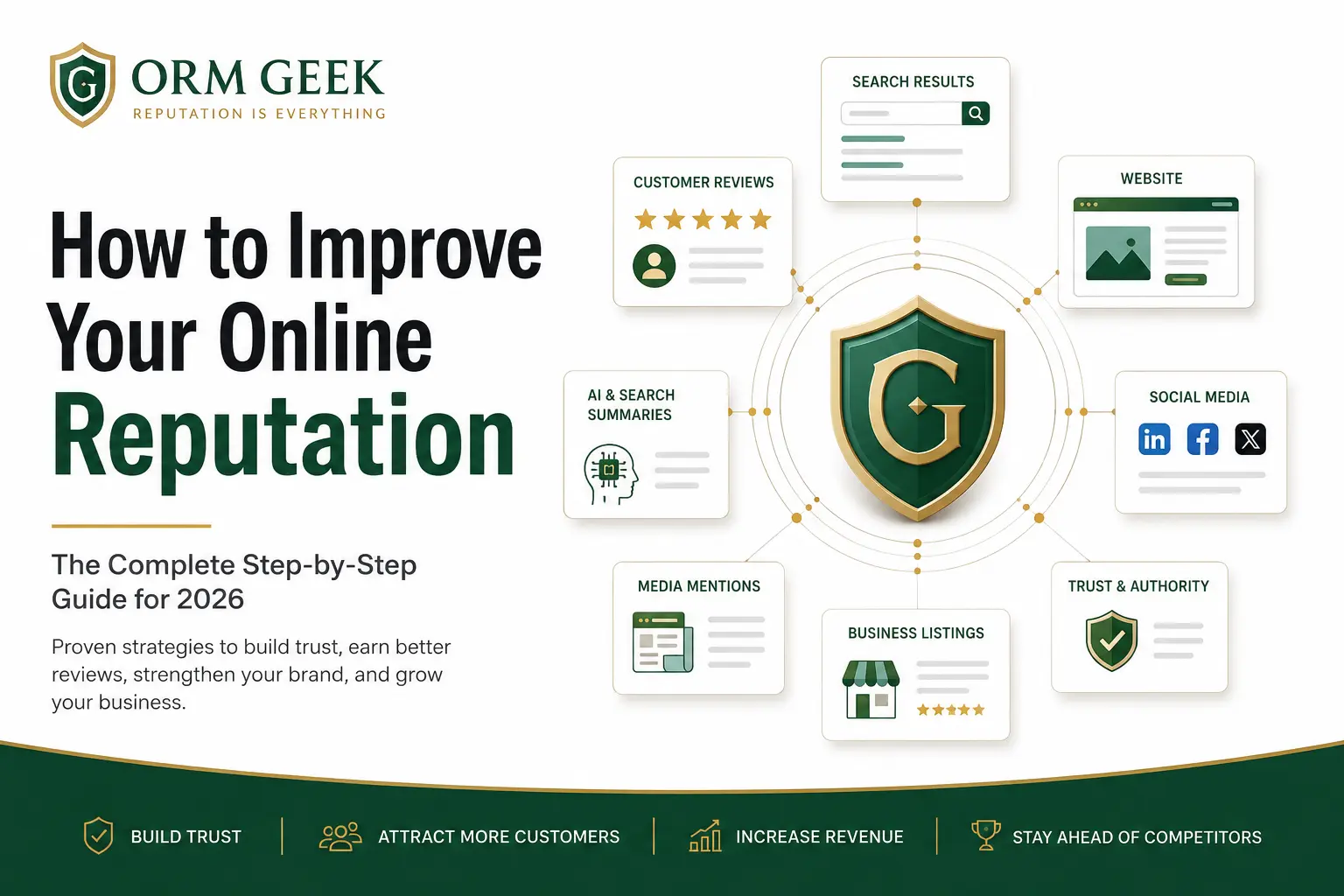
Your online reputation isn't built when someone becomes your customer. It's built long before they ever contact you.
Today's buyers rarely make decisions based on advertising alone. Before booking an appointment, requesting a proposal, or making a purchase, they conduct their own research. They search Google, read customer reviews, visit your website, compare competitors, explore your leadership team on LinkedIn, check recent news, and increasingly ask AI assistants for recommendations or summaries. Every interaction adds another piece of information that shapes their confidence in your business.
For most organizations, this evaluation happens silently. You'll never know how many opportunities were won because your digital presence inspired trust—or how many were lost because it raised unanswered questions.
Improving your online reputation means taking control of that experience.
Many businesses believe reputation improves by collecting more five-star reviews, publishing more content, or investing in search engine optimization. While these activities can help, they rarely deliver lasting results when treated as isolated tactics. Reputation isn't the outcome of a single platform or marketing campaign. It's the result of consistent customer experiences, credible digital evidence, and trust signals working together across every stage of the buyer's journey.
One of the biggest misconceptions about Online Reputation Management is that it's primarily about fixing problems. In reality, the strongest reputations are built proactively. Organizations that consistently deliver excellent customer experiences, respond thoughtfully to feedback, publish helpful content, maintain accurate business information, and earn independent recognition rarely need to "repair" their reputation because they are continuously strengthening it.
This shift in thinking is important.
Instead of asking:
- How do we remove negative reviews?
- How do we rank higher in Google?
- How do we look better online?
Successful organizations ask a different question:
What can we do today that will make people trust us more tomorrow?
That question changes everything. It shifts the focus from marketing activities to trust-building activities. Reviews become proof of customer satisfaction. Helpful content demonstrates expertise. Executive visibility reinforces credibility. Media coverage provides independent validation. Together, these signals create a digital presence that gives prospective customers confidence before they ever reach out.
Whether you're a local business, healthcare provider, law firm, financial services firm, hospitality brand, or B2B organization, the objective remains the same: build enough credible evidence that choosing your business becomes the obvious decision.
In this guide, you'll learn a practical framework for improving your online reputation—from auditing your current digital presence and strengthening customer trust to building authority, monitoring your reputation, and measuring long-term progress. Rather than relying on quick fixes or isolated tactics, you'll discover how to create a reputation that grows stronger with every customer interaction and every piece of digital evidence you publish.
Why Improving Your Online Reputation Is Harder Than It Looks
If improving your online reputation were as simple as collecting more five-star reviews or publishing more content, every business with a marketing budget would have an outstanding reputation.
In reality, many organizations invest significant time and resources into digital marketing yet struggle to earn the level of trust they expect. They redesign their websites, improve search rankings, stay active on social media, and encourage customers to leave reviews—only to find that enquiries, conversions, or brand perception change very little.
The reason is simple: reputation isn't built by individual tactics. It's built by the combined strength of every trust signal a customer encounters.
Today's buyers don't make decisions based on a single interaction. They build confidence by validating information across multiple sources. A prospective customer might discover your business through Google, read reviews, visit your website, explore your LinkedIn page, search for your leadership team, compare competitors, and even ask an AI assistant for recommendations—all before deciding whether to contact you.
If those touchpoints tell a consistent and credible story, trust grows naturally. If they create confusion or leave important questions unanswered, uncertainty takes its place.
The Five Challenges That Hold Businesses Back
Through our work with organizations across professional services, healthcare, hospitality, technology, and consumer brands, we've found that most reputation challenges stem from a handful of recurring issues.
1. Focusing on Visibility Instead of Credibility
Many businesses believe that ranking higher in search results or attracting more website visitors will automatically improve their reputation.
Visibility is important, but it only creates an opportunity to be evaluated. What people discover after they find you determines whether they trust you.
A business that ranks first but has outdated information, inconsistent messaging, or limited third-party validation may still lose customers to a competitor with stronger digital credibility.
2. Treating Reviews as the Entire Reputation Strategy
Customer reviews are among the most influential trust signals, but they are only one part of a much larger picture.
Prospective customers also evaluate your website, leadership team, industry recognition, media presence, educational content, and business information before making a decision.
Strong reviews can open the door, but they work best when supported by consistent evidence across every channel.
3. Ignoring the Customer Experience
Every review, testimonial, recommendation, or referral begins with a real customer experience.
Organizations often invest heavily in managing online perception while overlooking the operational improvements that naturally generate positive feedback. Sustainable reputation growth starts by improving what customers experience—not simply how the business presents itself online.
4. Inconsistent Digital Presence
One of the quickest ways to lose trust is through inconsistency.
Outdated contact details, incomplete business profiles, inactive social channels, missing executive biographies, and conflicting service information may seem like small issues individually, but together they create uncertainty.
Customers notice these inconsistencies far more often than businesses realise.
5. No Long-Term Reputation Strategy
Perhaps the biggest challenge is that many businesses approach reputation reactively.
They respond when a negative review appears, a media issue arises, or search results become a concern. Between those moments, reputation receives little attention.
The organizations with the strongest reputations take the opposite approach. They build systems that continuously strengthen customer experience, digital evidence, and public trust—making them far more resilient when challenges arise.
A Better Approach
Improving your online reputation shouldn't feel like managing dozens of disconnected marketing activities.
It should be a structured process that answers three simple questions:
- Where do we stand today?
- Which trust signals need the most attention?
- What should we improve first to create the greatest impact?
The answers form the foundation of a sustainable reputation strategy.
In the next section, we'll introduce the ORM Geek Reputation Improvement Framework™—a practical seven-stage approach that helps organizations strengthen trust systematically rather than relying on isolated tactics or quick fixes.
The ORM Geek Reputation Improvement Framework™
Improving your online reputation isn't about finding one tactic that delivers immediate results. It's about building a system that consistently strengthens how your organization is perceived over time.
At ORM Geek, we approach reputation improvement as a continuous process rather than a one-time project. Every customer interaction, review, article, media mention, leadership profile, and business update contributes to the digital evidence people use to decide whether they trust your organization.
The ORM Geek Reputation Improvement Framework™ brings these activities together into a practical, repeatable process. Instead of treating reviews, SEO, content marketing, public relations, and customer experience as separate initiatives, it aligns them around a single objective: building stronger trust at every stage of the customer journey.
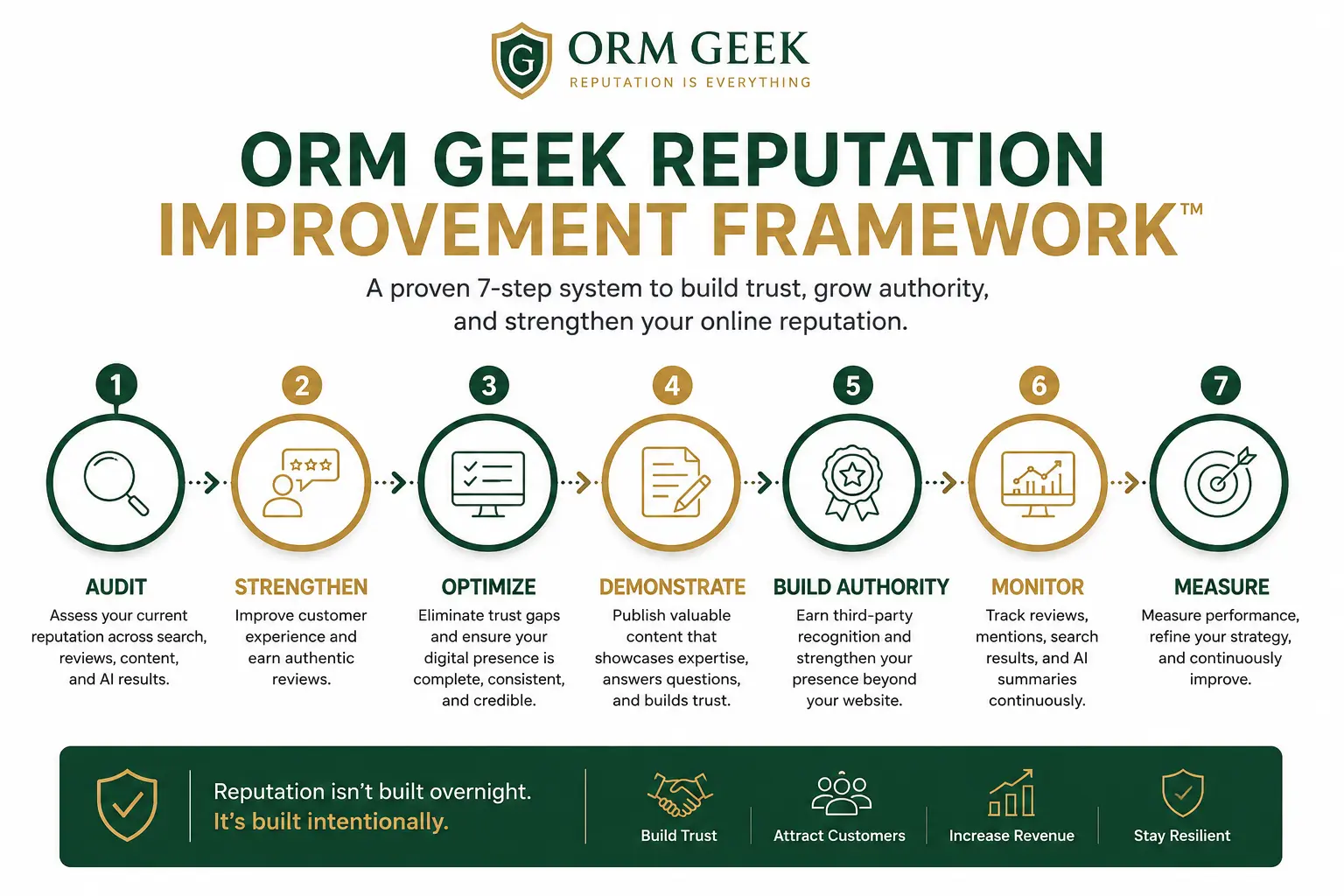
The framework consists of seven interconnected stages, each building on the one before it.
| Stage | Objective | Key Focus |
|---|---|---|
| Audit | Establish your baseline | Understand how people currently perceive your business. |
| Strengthen | Improve customer experience | Create experiences that naturally generate positive feedback. |
| Optimize | Eliminate trust gaps | Ensure your digital presence is complete, accurate, and consistent. |
| Demonstrate | Share your expertise | Publish helpful content that answers real customer questions. |
| Build Authority | Earn independent credibility | Strengthen trust through media, awards, partnerships, and thought leadership. |
| Monitor | Stay informed | Track reviews, mentions, search visibility, and emerging risks. |
| Measure | Improve continuously | Evaluate progress and refine your reputation strategy over time. |
Each stage supports the next. For example, asking for more customer reviews before improving the customer experience often leads to disappointing results. Similarly, investing in content marketing before fixing inconsistent business information may increase visibility without improving trust.
Reputation grows most effectively when these activities work together rather than in isolation.
One of the greatest advantages of this approach is that it works regardless of industry or organization size. Whether you're a local business, a healthcare provider, a law firm, a financial services firm, or a multinational enterprise, the underlying principles remain the same. The specific trust signals may differ, but the process of improving them follows a consistent path.
In the following sections, we'll explore each stage of the framework in detail, beginning with the most important step of all: understanding your current reputation before attempting to improve it.
Audit Your Current Online Reputation
Every successful reputation improvement strategy begins with a clear understanding of where you stand today.
Many organizations assume they know how they're perceived online because they receive positive customer feedback or have built a successful business over the years. However, the digital experience often tells a different story. A prospective customer doesn't see your internal strengths—they see the information available across search results, review platforms, business directories, news articles, social media, and increasingly, AI-generated summaries.
That's why the first step isn't to improve your reputation. It's to measure it objectively.
An Online Reputation Audit helps you identify the strengths that already build trust, the gaps that create uncertainty, and the opportunities that deserve immediate attention.
Evaluate Your Business Like a First-Time Customer
The simplest way to audit your reputation is to think like someone discovering your business for the first time.
Search for your business name, products or services, leadership team, and location. Review the first page of search results, visit your website, read recent customer reviews, and compare your digital presence with a few competitors.
Ask yourself a simple question:
If I knew nothing about this business, would I feel confident contacting it today?
The answer often reveals more than any internal marketing report.
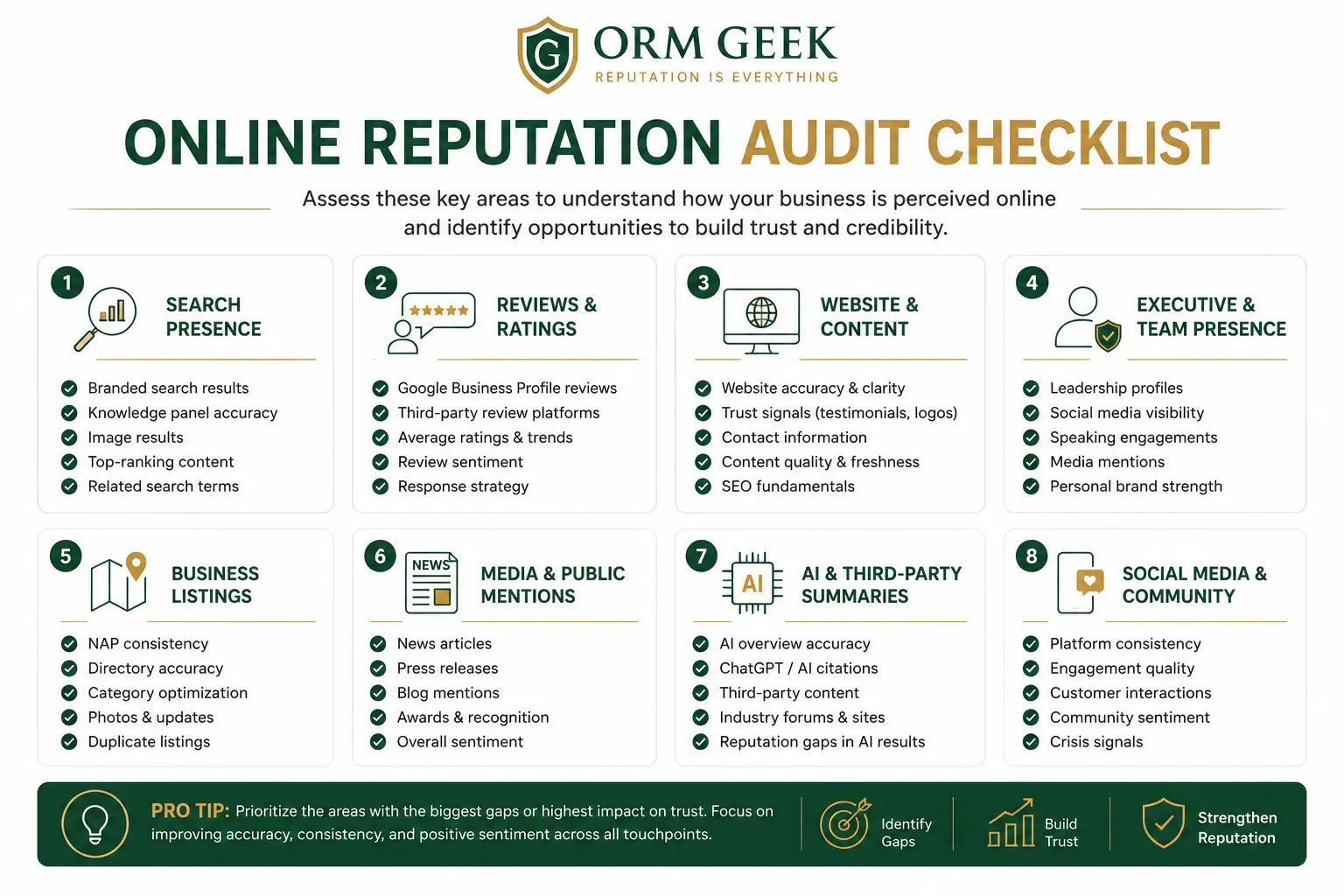
Your Reputation Audit Checklist
Rather than focusing on a single platform, evaluate the complete digital journey.
| Audit Area | What to Review |
|---|---|
| Search Visibility | Branded search results, knowledge panels, and third-party mentions |
| Customer Reviews | Rating, review quality, recency, and response management |
| Website Credibility | Clear messaging, trust signals, case studies, certifications, and contact information |
| Leadership Presence | LinkedIn profiles, executive bios, thought leadership, and public visibility |
| Digital Consistency | Business information across Google, directories, and social platforms |
| Third-Party Validation | Media coverage, awards, certifications, partnerships, and industry recognition |
| AI Visibility | How AI assistants describe your business and whether the information is accurate |
Prioritize Trust Gaps, Not Perfection
It's tempting to fix everything at once, but that's rarely the most effective approach.
Instead, identify the trust gaps that are most likely to influence customer decisions.
For one business, the priority may be improving customer reviews. For another, it may be updating outdated business listings, strengthening executive visibility, or creating more educational content.
The objective isn't to achieve a perfect online presence overnight. It's to establish a realistic baseline and focus on the improvements that will have the greatest impact on credibility.
Every improvement you make from this point forward becomes easier to measure because you've established where your reputation stands today.
Strengthen Customer Experience & Earn Better Reviews
Every online reputation begins offline.
Before customers leave a review, recommend your business, or share their experience with others, they interact with your organization. That interaction—whether positive, average, or disappointing—becomes the foundation of your reputation.
This is why businesses that focus only on generating more reviews often see limited results. Reviews don't create customer satisfaction; they reflect it.
Start by Improving the Customer Experience
The fastest way to improve your online reputation isn't by asking more people for reviews—it's by giving them more reasons to leave positive ones.
Look for the moments that shape a customer's perception of your business:
- Is your communication timely and professional?
- Do customers clearly understand your process?
- Are expectations set realistically?
- Is it easy to contact your team?
- Do you follow up after the service is complete?
- Are complaints resolved quickly and fairly?
Small improvements at these touchpoints often lead to significant improvements in customer satisfaction—and naturally increase positive feedback.
Build a Consistent Review Strategy
Satisfied customers are often willing to leave a review, but many simply need a reminder.
Create a simple, consistent process for requesting feedback shortly after a successful interaction. Make it easy by providing a direct review link and thanking customers for sharing their experience.
The objective isn't to collect the highest number of reviews—it's to build a steady stream of authentic, recent feedback that accurately reflects the quality of your service.
Respond to Every Review
Responding to reviews demonstrates that your business values customer feedback.
Thank customers for positive reviews, acknowledge constructive criticism, and respond professionally to negative experiences. Prospective customers pay close attention not only to what people say about your business, but also to how you respond when things don't go as planned.
A thoughtful response can reinforce trust even when the original review isn't perfect.
Focus on Trends, Not Individual Reviews
No business receives perfect feedback forever.
Rather than reacting emotionally to every review, look for recurring themes. If several customers mention slow communication, confusing processes, or exceptional service from a particular team member, those patterns provide valuable insights for continuous improvement.
The goal isn't to eliminate every negative review. It's to ensure that the overall customer experience consistently generates more positive evidence than negative.
Eliminate Trust Gaps Across Your Digital Presence
Even the best businesses can lose credibility because of small inconsistencies.
An outdated phone number, an incomplete Google Business Profile, broken website links, missing executive biographies, or conflicting business descriptions may seem insignificant on their own. Together, however, they create uncertainty—and uncertainty is the enemy of trust.
Customers rarely point out these issues. Instead, they simply move on to a competitor that appears more credible and complete.
That's why one of the quickest ways to improve your online reputation is to eliminate the trust gaps that exist across your digital presence.
Start With the Essentials
Begin by reviewing the information that customers expect to find immediately.
Ask yourself:
- Is your business name consistent across every platform?
- Are your address, phone number, and website accurate?
- Are your operating hours current?
- Do your service descriptions reflect what you offer today?
- Is it easy for customers to contact you?
Consistency across these fundamentals creates confidence before a customer even speaks to your team.
Strengthen Your Digital Trust Signals
Once the basics are in place, focus on the elements that reinforce credibility.
A trustworthy online presence typically includes:
- A complete Google Business Profile
- An up-to-date, secure website
- Professional leadership and team profiles
- Clear service or product information
- Customer testimonials and case studies
- Certifications, awards, or industry memberships
- Recent news, insights, or educational resources
Individually, these trust signals may seem small. Together, they create a stronger and more convincing digital presence.
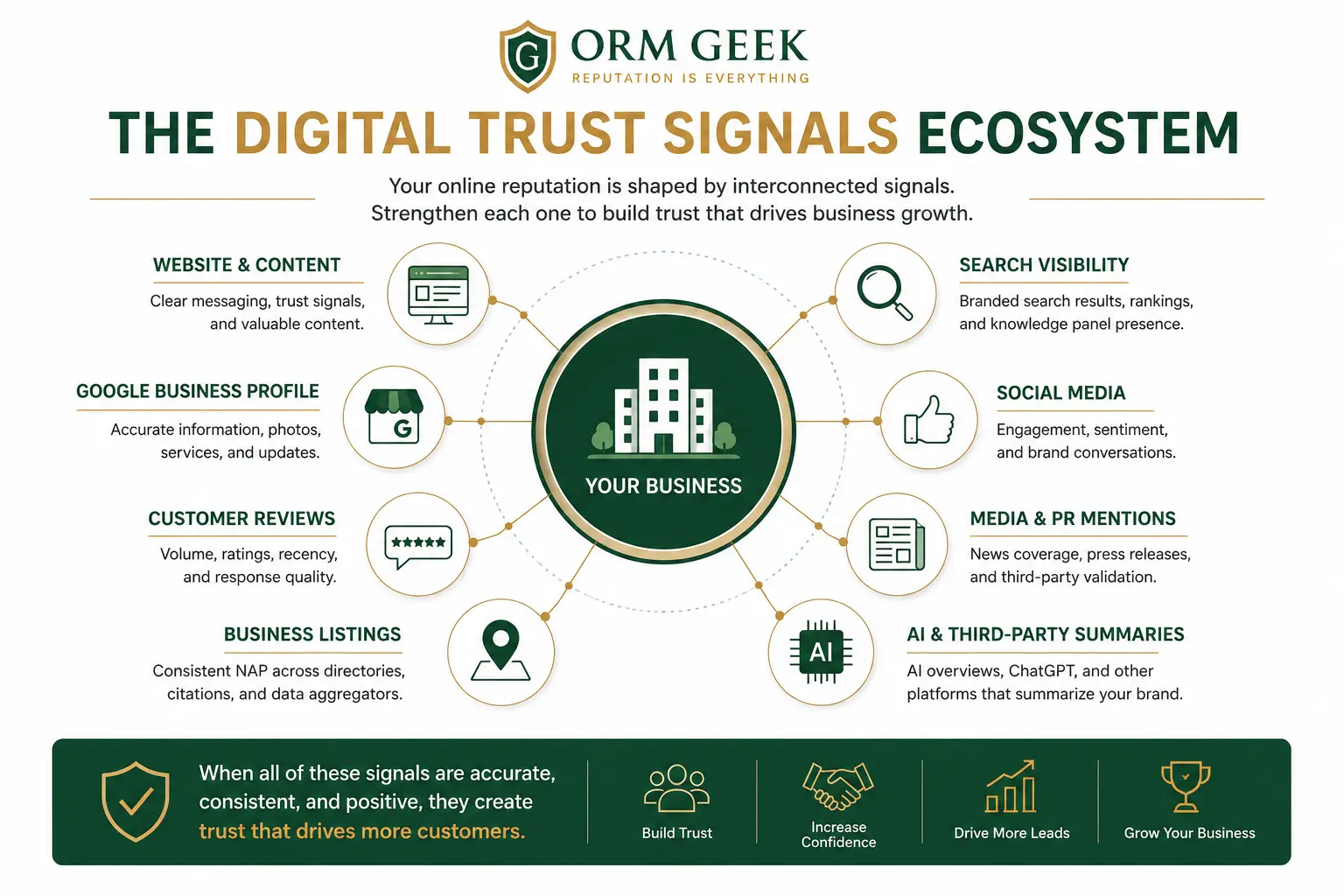
Keep Every Platform Aligned
Many businesses update their website but forget about business directories, industry listings, social profiles, or local citations.
This creates conflicting information across the web, making it difficult for both customers and search engines to determine which details are accurate.
Develop a simple process for reviewing your digital assets regularly and updating them whenever your business changes. Whether it's a new office, revised services, updated branding, or changes to your leadership team, consistency should extend across every platform where your business appears.
Don't Forget AI Search
Increasingly, potential customers are asking AI assistants questions like:
- What does this company do?
- Is this business reputable?
- Who are its competitors?
These answers are generated from the digital evidence available across the web.
If your business information is outdated, incomplete, or inconsistent, AI systems may produce inaccurate or incomplete summaries.
By maintaining accurate business profiles, publishing helpful content, earning third-party recognition, and keeping your digital presence consistent, you improve not only what customers see—but also how AI platforms understand and describe your business.
Publish Content That Builds Trust
Your website shouldn't just tell people what you do—it should help them understand why they should trust you.
One of the biggest mistakes organizations make is treating content as a marketing activity rather than a reputation-building asset. Their websites are filled with service pages, promotional messaging, and company updates, but very little that helps prospective customers make informed decisions.
Today's buyers expect more. Before contacting a business, they want answers to their questions, explanations of complex topics, proof of expertise, and confidence that they're choosing the right provider.
Helpful content provides that confidence.
Answer the Questions Your Customers Are Already Asking
Every business receives the same questions repeatedly.
Instead of answering them one conversation at a time, turn those questions into valuable content.
Think about topics such as:
- Common misconceptions in your industry
- Frequently asked questions
- Pricing and buying considerations
- Step-by-step guides
- Case studies and success stories
- Industry trends and insights
Content that educates first and sells second builds far more trust than content focused solely on promotion.
Demonstrate Expertise Through Real Knowledge
People trust businesses that openly share what they know.
Whether you're a law firm explaining legal procedures, a healthcare provider simplifying treatment options, or a cybersecurity company discussing emerging threats, educational content positions your organization as a credible source of information.
Over time, this creates a library of digital evidence that benefits both prospective customers and search engines.
Diversify the Way You Share Knowledge
Not every customer prefers reading long articles.
Consider presenting your expertise through multiple formats, including:
- Blog articles
- FAQs
- Videos
- Infographics
- Downloadable guides
- Webinars
- Case studies
Repurposing the same expertise across different formats expands your reach while reinforcing consistent messaging.
Write for People First, Search Engines Second
Search visibility remains important, but content should always prioritize the reader.
Ask yourself:
- Does this answer a genuine customer question?
- Is the information accurate and easy to understand?
- Does it demonstrate real expertise?
- Would someone find it helpful even if they never became a customer?
If the answer is yes, you've created content that strengthens your reputation—not just your rankings.
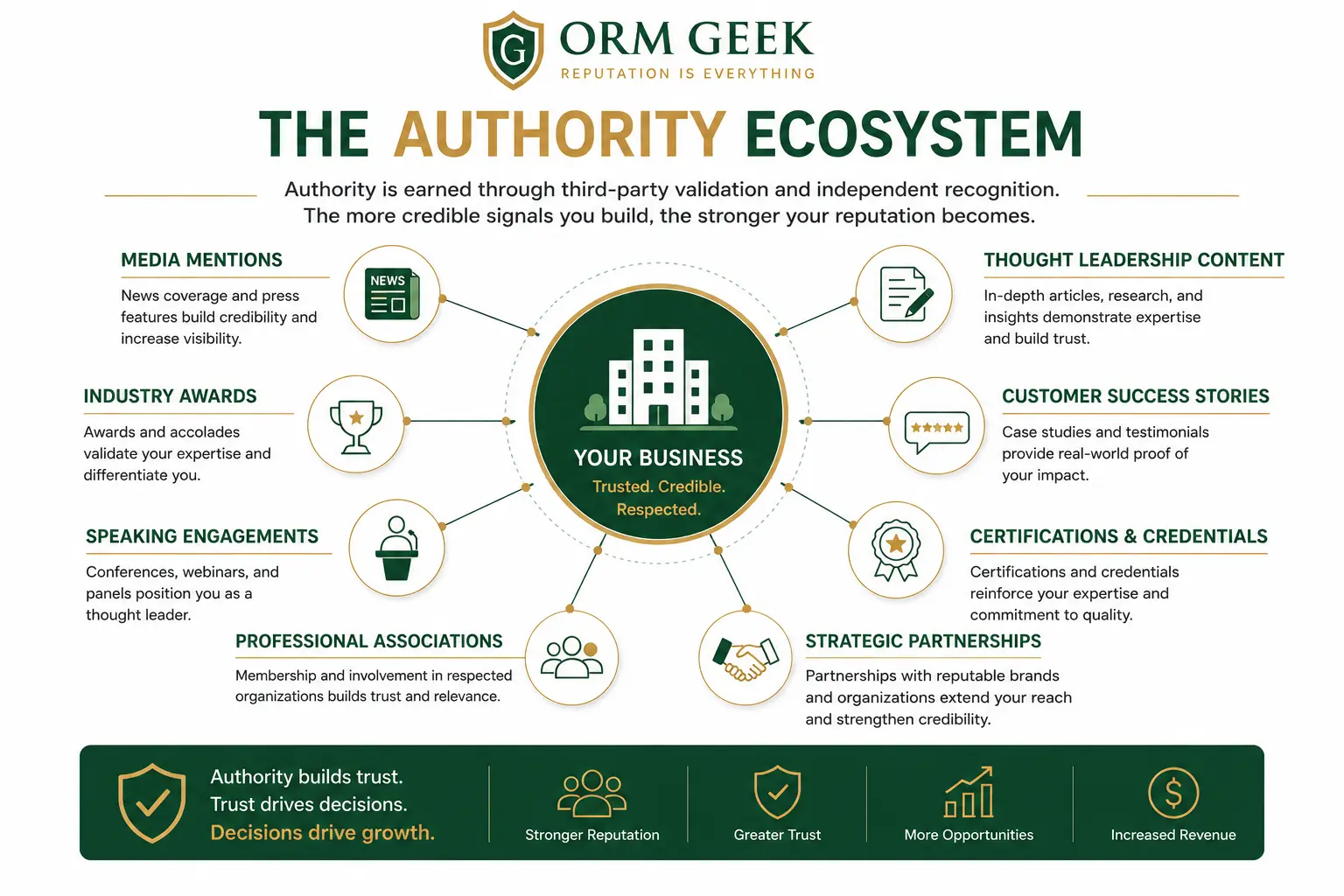
Build Authority Beyond Your Website
A strong website and positive customer reviews are essential, but they aren't the only factors people consider when evaluating your business.
The highest levels of trust are often earned through independent recognition. When respected publications, industry associations, conference organizers, partners, and other third parties acknowledge your expertise, they provide validation that your own marketing simply cannot.
This is the difference between claiming expertise and having it recognised by others.
Earn Recognition, Don't Chase Publicity
Authority isn't about appearing everywhere. It's about appearing in the places that matter to your audience.
For some organizations, that may mean contributing expert commentary to industry publications. For others, it could involve speaking at conferences, publishing research, participating in professional associations, or earning recognised certifications.
The objective isn't visibility for its own sake—it's building independent proof that reinforces your expertise.
Strengthen Your Executive Presence
In many industries, people evaluate the leadership team before they evaluate the business itself.
Founders, executives, physicians, lawyers, consultants, and other subject matter experts often become powerful trust signals. Their professional profiles, articles, interviews, presentations, and public insights shape how customers perceive the organizations they represent.
An active and credible executive presence strengthens the business as a whole, while an outdated or invisible leadership team can create unnecessary doubt.
Build Relationships That Increase Credibility
Authority grows through participation, not isolation.
Look for opportunities to contribute beyond your own website:
- Publish guest articles on respected industry platforms.
- Participate in webinars and podcasts.
- Speak at conferences and professional events.
- Join recognised industry associations.
- Collaborate with trusted partners and organizations.
- Share original research, insights, or data.
Each of these activities creates additional digital evidence that strengthens your reputation across search engines, AI platforms, and the broader web.
Think Long Term
Authority isn't built through a single media mention or award.
It's the result of consistently demonstrating expertise over time. Every interview, published article, conference presentation, industry contribution, or professional recognition adds another layer of credibility that makes your organization easier to trust.
Unlike advertising, these trust signals continue delivering value long after they're created because they become part of your permanent digital footprint.
Monitor Your Online Reputation Continuously
Improving your online reputation isn't a one-time project. Every customer interaction, review, media mention, and online conversation has the potential to strengthen—or weaken—how your business is perceived.
That's why reputation should be monitored continuously, not only when a problem arises.
Organizations that monitor their digital presence regularly can identify emerging issues early, respond more effectively to customer feedback, and recognize new opportunities to strengthen trust before competitors do.
What Should You Monitor?
A comprehensive reputation monitoring process should include:
- Customer reviews across major platforms
- Branded search results
- Google Business Profile updates
- Media mentions and press coverage
- Social media conversations
- Executive and leadership visibility
- Competitor activity
- AI-generated summaries of your business
Rather than checking these channels only when something goes wrong, establish a regular review process. Monthly monitoring helps identify trends, while quarterly audits provide a broader view of how your reputation is evolving.
📍Insert Graphic Here: Online Reputation Monitoring Dashboard
Reviews • Search • Media • Social • AI • Competitors • Business Listings
Focus on Patterns, Not Individual Events
Not every negative review requires a major response, and not every positive mention signals long-term success.
Look for recurring patterns.
Are review ratings improving?
Are customer complaints becoming less frequent?
Is your business appearing in more authoritative publications?
Are AI platforms describing your organization more accurately?
Tracking these trends provides a far more meaningful picture than reacting to isolated events.
Measure, Refine & Improve
The final stage of reputation improvement is measurement.
Without meaningful metrics, it's impossible to know whether your efforts are actually strengthening trust or simply increasing visibility.
While review ratings and website traffic remain useful indicators, they tell only part of the story. A stronger approach is to evaluate reputation across multiple trust signals that reflect how customers, search engines, and AI systems perceive your business.
The ORM Geek Reputation Scorecard™
Rather than relying on a single "reputation score," measure progress across the areas that matter most.
| Area | What to Measure |
|---|---|
| Customer Reviews | Rating trends, freshness, response rate |
| Search Visibility | Branded search results and positive coverage |
| Website Trust | Case studies, testimonials, trust signals |
| Authority | Media mentions, awards, certifications, backlinks |
| Executive Presence | Leadership visibility and thought leadership |
| Digital Consistency | Accuracy across listings and platforms |
| AI Visibility | Quality and accuracy of AI-generated summaries |
📍Insert Graphic Here: ORM Geek Reputation Scorecard™
Review these indicators regularly to understand where you're improving and where additional attention is needed.
Remember, reputation isn't measured by one outstanding review or one successful campaign. It's measured by the steady accumulation of credible evidence over time.
The Biggest Mistakes That Prevent Reputation Growth
Most organizations don't damage their reputation through one major mistake. More often, trust erodes gradually through overlooked details, inconsistent practices, and missed opportunities.
The encouraging news is that many of these issues are entirely preventable. By recognizing them early, businesses can strengthen their reputation before small weaknesses become larger challenges.
Mistake 1: Treating Reputation as a Marketing Activity
Many businesses believe Online Reputation Management belongs solely to the marketing team.
In reality, reputation is shaped across the entire organization. Customer service influences reviews, operations determine customer experience, leadership builds credibility, HR affects employer reputation, and marketing communicates the story.
Organizations that view reputation as a shared responsibility consistently build stronger, more resilient brands.
Mistake 2: Chasing Reviews Instead of Improving Experiences
Reviews are an outcome—not the objective.
Businesses that focus exclusively on increasing review volume often overlook the experiences that generate authentic advocacy. Sustainable reputation growth begins by improving service quality, communication, and customer satisfaction.
When the experience improves, positive reviews follow naturally.
Mistake 3: Saying More Than You Can Prove
Every business claims to be experienced, customer-focused, or industry-leading.
Prospective customers don't trust those claims until they see evidence that supports them.
Case studies, testimonials, certifications, media coverage, awards, thought leadership, and educational content provide the proof that marketing alone cannot.
Mistake 4: Ignoring Digital Consistency
Outdated business information, incomplete profiles, broken links, and inconsistent messaging create unnecessary doubt.
Even small inconsistencies can weaken confidence when customers are comparing multiple providers.
Keeping your digital presence accurate and aligned is one of the simplest ways to strengthen trust.
Mistake 5: Neglecting Executive Reputation
For many organizations, people trust the leadership before they trust the company.
Founders, executives, physicians, lawyers, consultants, and subject matter experts all influence buying decisions through their visibility and credibility.
An active leadership presence reinforces organizational trust, while an absent one often leaves important questions unanswered.
Mistake 6: Measuring the Wrong Success Metrics
Website traffic, social followers, and keyword rankings are useful indicators—but they don't measure trust.
A stronger reputation is reflected through improving customer sentiment, stronger branded search results, increasing third-party recognition, consistent reviews, and growing authority across the web.
Focus on the metrics that indicate growing confidence, not just growing visibility.
Mistake 7: Waiting for a Crisis
Perhaps the biggest mistake is believing reputation only matters when something goes wrong.
By the time negative publicity, poor reviews, or misinformation become urgent problems, rebuilding trust is significantly more difficult.
The strongest reputations are built continuously, making organizations more resilient when challenges inevitably arise.
Reputation Growth Is a Long-Term Investment
Every review you respond to, every helpful article you publish, every customer experience you improve, and every piece of independent recognition you earn contributes to something much larger than a stronger online presence.
It creates confidence.
And confidence influences every stage of business growth—from attracting new customers and recruiting talented employees to earning referrals, partnerships, and long-term loyalty.
Organizations that consistently invest in trust rarely need dramatic reputation recovery because they have already built a foundation that withstands occasional setbacks.
Your 90-Day Online Reputation Improvement Plan
Improving your online reputation doesn't require a complete overhaul overnight. The most successful organizations make consistent improvements that build momentum over time.
Rather than trying to fix everything at once, focus on strengthening one group of trust signals at a time. By the end of 90 days, you'll have a stronger digital presence, better customer validation, and a more credible online footprint that continues to grow long after the initial work is complete.
Month 1: Build the Foundation
The first month is about understanding where your reputation stands today and fixing the fundamentals that influence first impressions.
Priorities
- Complete a comprehensive online reputation audit.
- Review your branded search results.
- Update your Google Business Profile and business listings.
- Ensure your website contains clear trust signals, testimonials, and contact information.
- Audit customer reviews and identify recurring feedback.
- Create a simple, consistent process for requesting reviews.
Success looks like:
✓ Accurate business information across major platforms.
✓ A clear understanding of your strongest trust signals and biggest credibility gaps.
Month 2: Strengthen Your Digital Evidence
With the foundation in place, focus on creating the evidence that helps prospective customers trust your business.
Priorities
- Publish educational content that answers customer questions.
- Refresh service pages with stronger proof points.
- Add case studies, testimonials, or client success stories.
- Improve executive and team profiles.
- Continue generating authentic customer reviews.
- Respond consistently to every new review.
Success looks like:
✓ A growing library of helpful content.
✓ More recent customer feedback.
✓ Stronger credibility across your website and digital channels.
Month 3: Build Authority & Maintain Momentum
The final month focuses on expanding your reputation beyond your own website while establishing processes that support long-term growth.
Priorities
- Pursue media opportunities, guest articles, or podcast appearances.
- Participate in industry events or professional associations.
- Publish thought leadership content.
- Monitor reviews, search results, and AI-generated summaries.
- Review your reputation KPIs and identify the next priorities.
Success looks like:
✓ Increased third-party validation.
✓ Greater visibility for your expertise.
✓ A sustainable reputation management process that continues beyond the first 90 days.
📍Insert Graphic Here: 90-Day Reputation Improvement Roadmap
Timeline: Month 1 → Foundation | Month 2 → Digital Evidence | Month 3 → Authority & Growth
Remember: Reputation Is Never Finished
The first 90 days establish momentum, but reputation management is an ongoing discipline rather than a one-time initiative.
Every positive customer experience, thoughtful review response, helpful article, media mention, and industry contribution becomes another piece of digital evidence that strengthens trust.
Organizations that continue investing in these activities consistently outperform those that only focus on reputation when problems arise.
Reputation Is Earned Every Day
Your online reputation isn't defined by a single review, a viral social media post, or a successful marketing campaign. It's shaped by the hundreds of interactions, conversations, and digital signals that collectively influence how people perceive your business.
Every satisfied customer, every helpful article, every thoughtful response to feedback, and every piece of independent recognition adds to the body of evidence that prospective customers use to decide whether they trust you.
That's why improving your online reputation isn't about chasing quick wins. It's about building a system that consistently creates trust.
Throughout this guide, we've explored a practical framework for doing exactly that—from auditing your current reputation and strengthening customer experience to eliminating trust gaps, publishing valuable content, building authority, and measuring long-term progress.
The businesses that succeed aren't necessarily those with the biggest marketing budgets. They're the ones that make it easy for people to verify their credibility at every stage of the buying journey.
Whether you're a local business, healthcare provider, law firm, financial services firm, hospitality brand, or enterprise organization, the principles remain the same. Focus on creating exceptional experiences, communicate with transparency, demonstrate genuine expertise, and continuously strengthen the digital evidence surrounding your business.
Reputation is never truly finished. It evolves with every customer interaction and every new piece of information published about your organization. Businesses that treat reputation as an ongoing business function—not a reactive marketing task—are better positioned to earn customer confidence, withstand challenges, and achieve sustainable growth.
Frequently Asked Questions (FAQs)
1. How long does it take to improve an online reputation?
The timeline depends on your current reputation, industry, and level of competition. Businesses can often see improvements in review quality, search visibility, and customer engagement within a few months, while building long-term authority and trust is an ongoing process.
2. Can I improve my online reputation without removing negative reviews?
Yes. The goal isn't to eliminate every negative review but to ensure positive, authentic experiences consistently outweigh occasional criticism. Responding professionally and improving customer experience often has a greater impact than trying to remove reviews.
3. What is the fastest way to improve my online reputation?
Start by auditing your digital presence, fixing inaccurate business information, improving customer experience, and implementing a consistent review strategy. These changes create a strong foundation before investing in broader reputation-building activities.
4. Are customer reviews the most important part of Online Reputation Management?
Reviews are one of the strongest trust signals, but they are only one part of your reputation. Search results, website credibility, leadership visibility, media recognition, educational content, and business consistency all influence how people perceive your organization.
5. How does content help improve online reputation?
Helpful content demonstrates expertise, answers customer questions, and provides evidence that your business understands its industry. Over time, this strengthens trust with both prospective customers and search engines.
6. Why is executive reputation important?
In many industries, customers research founders, executives, or specialists before contacting a business. A visible, credible leadership team reinforces organizational trust and demonstrates expertise beyond the company's marketing.
7. Does AI affect online reputation?
Yes. AI assistants increasingly summarize businesses using publicly available information from trusted sources. Maintaining accurate business information, publishing helpful content, and earning third-party recognition helps ensure AI systems represent your business more accurately.
8. How often should I monitor my online reputation?
Review customer feedback, branded search results, and online mentions regularly, with a more comprehensive reputation audit at least every quarter. Continuous monitoring helps identify opportunities and potential issues before they affect customer trust.
9. What should I measure to know if my reputation is improving?
Look beyond review ratings. Track review trends, branded search visibility, customer sentiment, media mentions, executive visibility, digital consistency, and the overall quality of the trust signals supporting your business.
10. Should Online Reputation Management be an ongoing process?
Absolutely. Reputation evolves with every customer interaction, review, content update, and public mention. Organizations that invest in reputation continuously are better positioned to attract customers, withstand challenges, and achieve sustainable growth.