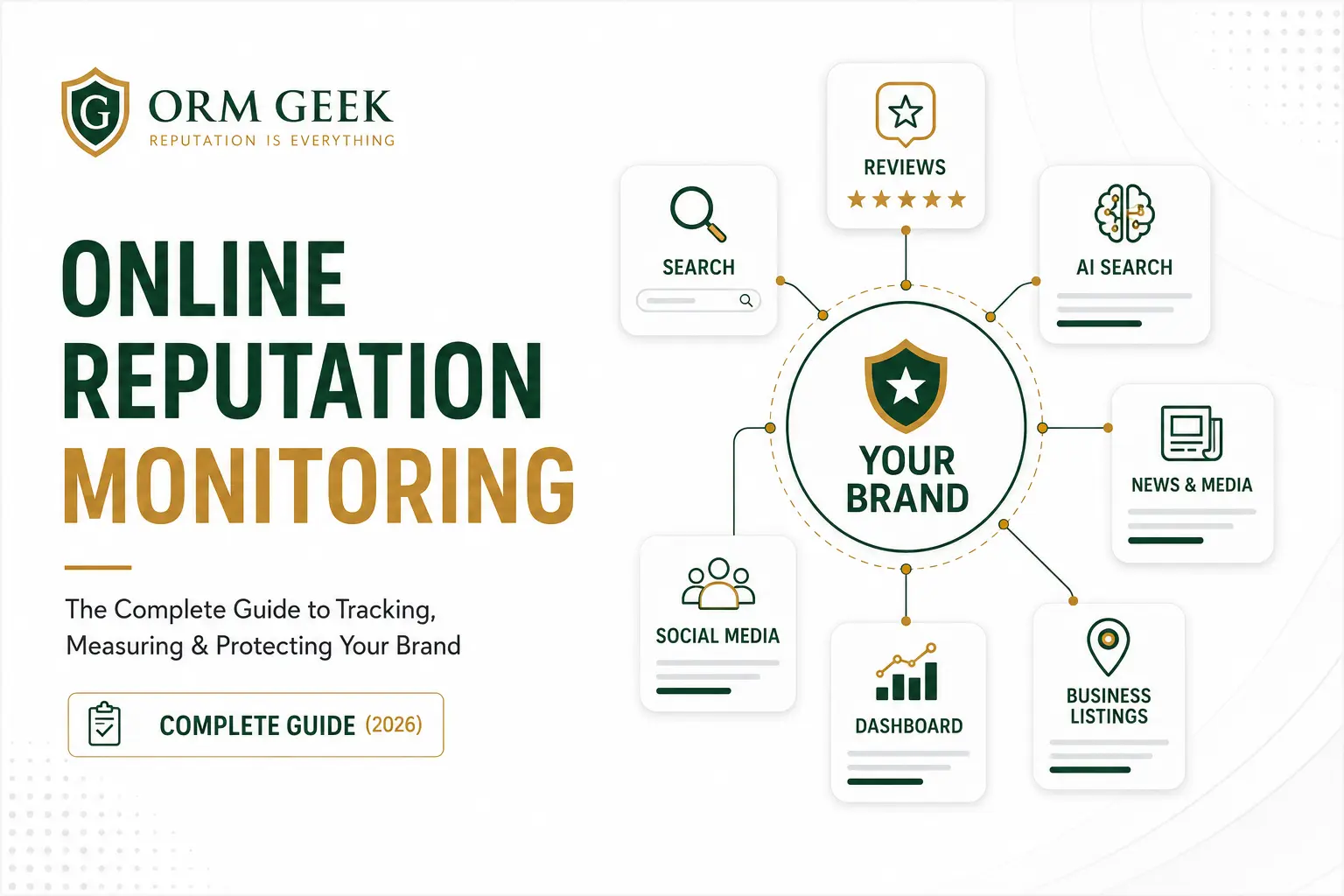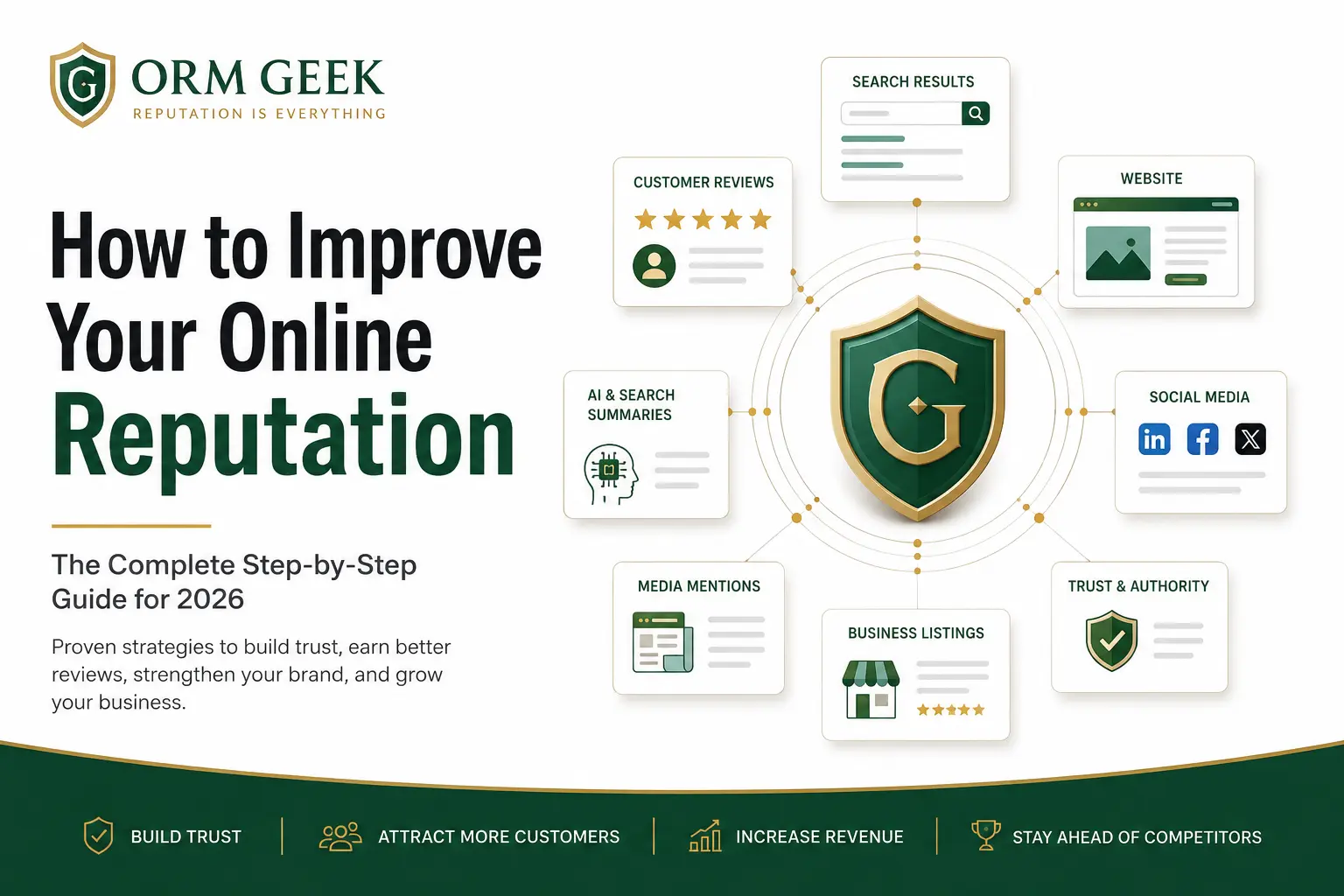
Before people trust your business, they trust the evidence they find.
Long before a prospective customer schedules a consultation, requests a proposal, or visits your office, they've already begun evaluating your organization. They search Google, read reviews, compare competitors, visit your website, explore your leadership team on LinkedIn, look for recent news, and increasingly ask AI assistants for recommendations or summaries. Every interaction contributes to a first impression that influences whether they move forward with confidence or continue their search elsewhere.
For most organizations, this research happens silently. You'll rarely know how many opportunities were won because your digital presence inspired confidence—or how many were lost because it raised unanswered questions.
This shift has fundamentally changed the role of Online Reputation Management (ORM). What was once viewed as a reactive service for handling negative reviews or unfavourable search results has evolved into a strategic business function. Today, reputation influences customer acquisition, executive credibility, recruitment, investor confidence, partnership opportunities, and even how AI systems understand and recommend organizations.
The organizations that consistently earn trust online are rarely those with the loudest marketing. They're the ones that create a consistent, credible, and verifiable digital presence across every touchpoint that matters.
What Is Online Reputation Management?
Online Reputation Management (ORM) is the strategic process of building, monitoring, protecting, and strengthening how an individual, business, or organization is perceived online. It combines customer experience, review management, search visibility, media relations, executive positioning, content strategy, and digital governance to ensure that public perception accurately reflects the quality, credibility, and expertise of the organization.
Many definitions describe ORM simply as managing perception. While technically accurate, that explanation overlooks what actually shapes perception in the first place.
A more practical way to understand ORM is to focus on the information people rely on when making decisions. Customers, investors, journalists, regulators, employees, and AI systems all assess an organization using publicly available signals. Reviews, media coverage, business listings, leadership profiles, certifications, educational content, and customer experiences collectively influence whether an organization appears trustworthy.
A Better Way to Think About Reputation
At ORM Geek, we define reputation as the accumulation of digital evidence.
Every review, article, recommendation, case study, interview, award, customer interaction, and expert mention adds another piece of evidence. Individually, these signals carry limited influence. Together, they create a body of proof that either strengthens or weakens trust.
This perspective changes the objective of Online Reputation Management. Instead of asking, "How do we improve our reviews?" or "How do we rank higher for our brand name?", organizations begin asking a more valuable question:
That question leads to better decisions because it addresses the root cause of reputation rather than individual symptoms.
This is the foundation of effective Online Reputation Management. Rather than chasing isolated metrics, successful organizations focus on consistently creating credible digital evidence that supports long-term trust.
Why Online Reputation Matters More Than Ever
Reputation has always influenced business decisions, but the way people evaluate trust has changed fundamentally.
Instead of relying on advertisements or direct conversations, people now conduct their own research before engaging with a business. Whether they're choosing a law firm, comparing healthcare providers, evaluating financial advisors, or shortlisting B2B vendors, they build confidence by validating information across multiple independent sources.
A typical research journey rarely begins and ends with a single Google search. Prospective customers often explore reviews, visit the company's website, research its leadership team on LinkedIn, read recent news coverage, compare competitors, and increasingly ask AI assistants for recommendations or summaries. Individually, each source reveals only part of the story. Together, they create the level of confidence needed to move forward—or the uncertainty that sends people elsewhere.
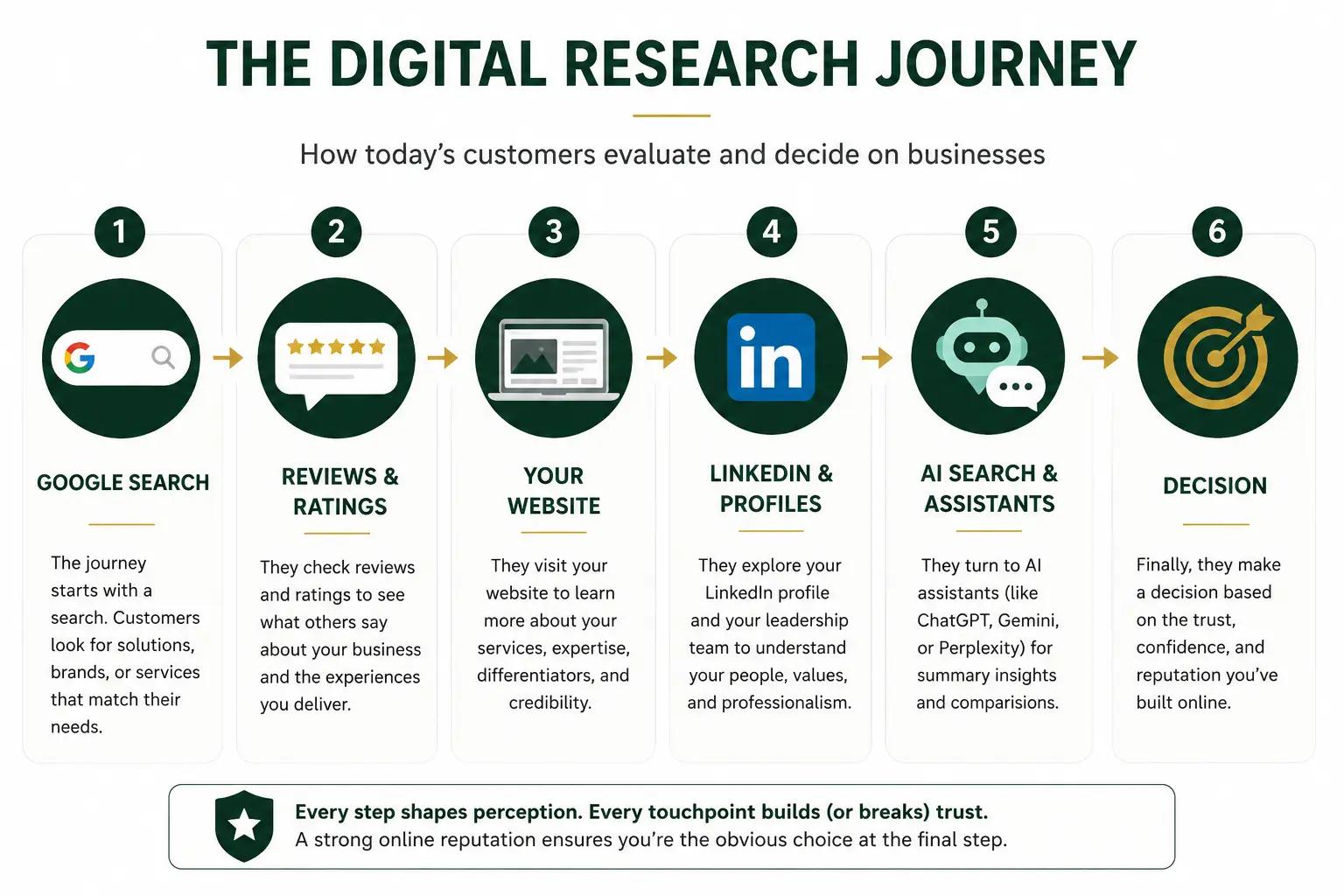
This shift has expanded the role of Online Reputation Management far beyond marketing. Today, reputation influences customer acquisition, recruitment, partnerships, investor confidence, executive credibility, media relationships, and even how AI systems understand and recommend organizations.
For many businesses, reputation has become a strategic asset that directly supports long-term growth.
Reputation Is Built Through Digital Evidence
One of the biggest misconceptions about Online Reputation Management is that it revolves around reviews.
Reviews certainly matter, but they're only one piece of a much larger picture.
Think about how you evaluate an unfamiliar business. You probably don't rely on its average star rating alone. You visit its website, explore customer testimonials, review leadership profiles, check how long it has been operating, look for recent news, and compare information across multiple platforms.
The more important the decision, the more evidence you seek before making it.
This is why reputation is best understood as a system rather than a single marketing channel. Every customer interaction, article, review, business profile, recommendation, and expert mention contributes another signal that either reinforces or weakens trust.
The ORM Geek Digital Evidence Framework™
Traditional discussions about Online Reputation Management often focus on platforms. Businesses are encouraged to collect more reviews, improve SEO, publish content, or become more active on social media.
While these activities are valuable, they explain where reputation is influenced—not how it is actually built.
The ORM Geek Digital Evidence Framework™ provides a more practical way to understand how trust develops online.
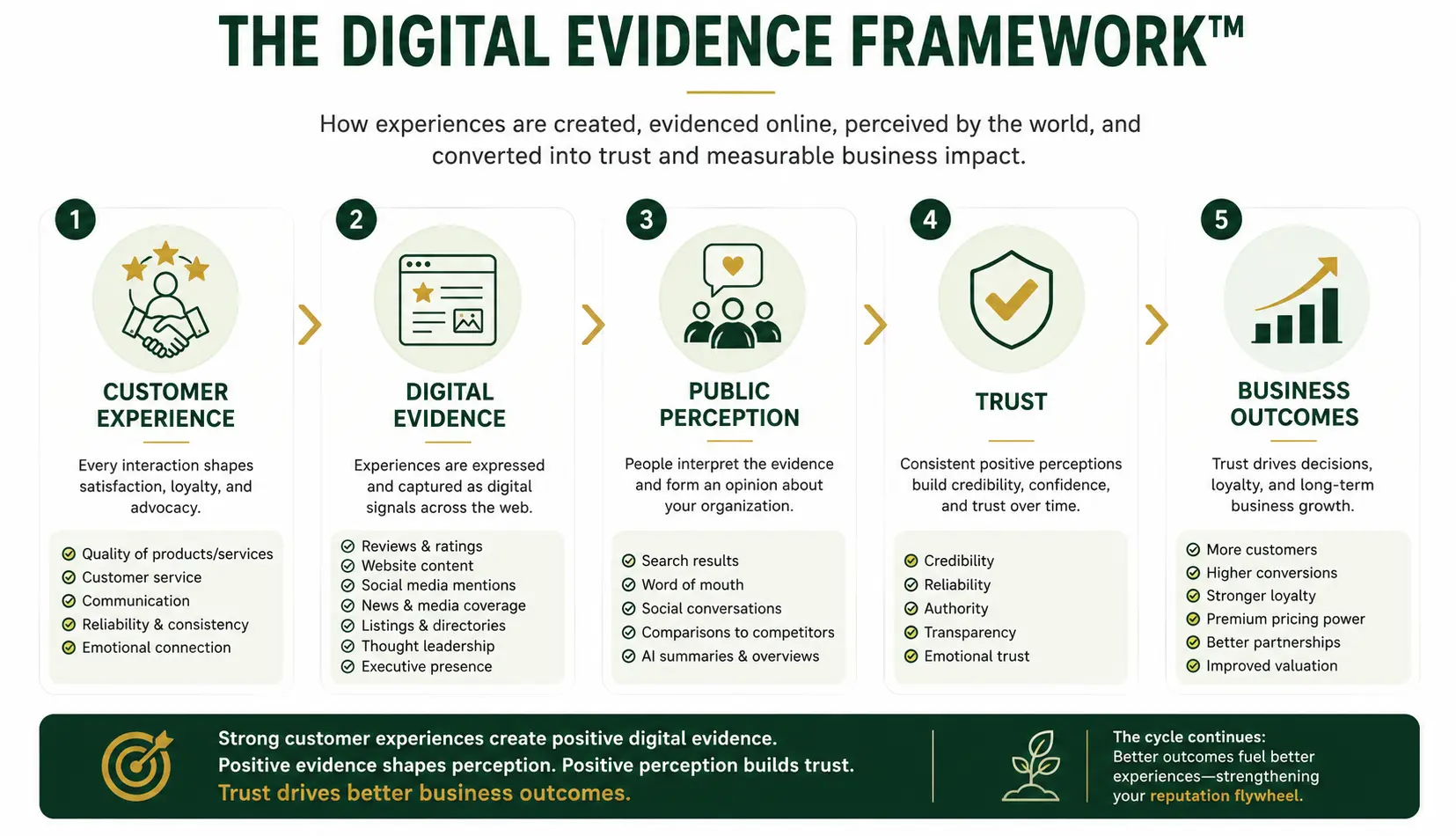
Customer Experience → Digital Evidence → Public Perception → Trust → Business Outcomes
| Stage | What It Represents | Business Question |
|---|---|---|
| Customer Experience | The quality of real-world interactions | Are we consistently delivering on our promises? |
| Digital Evidence | Reviews, content, media mentions, profiles, awards and public trust signals | What proof exists online? |
| Public Perception | How stakeholders interpret that evidence | Do we appear credible and trustworthy? |
| Trust | The confidence people develop before engaging | Would someone choose us over a competitor? |
| Business Outcomes | Leads, conversions, referrals, partnerships and growth | Is our reputation supporting business objectives? |
Every organization moves through this sequence whether it manages its reputation intentionally or not.
Businesses that focus only on visibility often overlook the evidence supporting that visibility. Others concentrate on collecting reviews while neglecting executive credibility, thought leadership, or customer experience. Sustainable reputation is built when every stage strengthens the next.
Reputation Is Now a Business Advantage
A strong reputation does far more than improve public perception.
It reduces uncertainty, shortens buying cycles, improves conversion rates, attracts higher-quality talent, strengthens investor confidence, and increases customer loyalty. It also helps organizations perform better in search engines and AI-powered discovery, where credibility is increasingly determined by consistent information from multiple trusted sources.
Conversely, outdated business information, unresolved customer complaints, inconsistent messaging, or a weak digital presence can create hesitation—even when the underlying product or service is exceptional.
Organizations that consistently invest in building trust don't simply protect their reputation. They create a competitive advantage that's difficult for others to replicate.
How Online Reputation Management Works
Understanding what influences reputation is only the first step. The next challenge is managing it consistently.
Many organizations approach Online Reputation Management as a collection of disconnected activities. Marketing teams publish content, customer support responds to reviews, PR manages media relationships, legal teams handle harmful content, and leadership focuses on executive visibility. While each function contributes to reputation, they often operate independently, creating gaps that weaken overall trust.
Effective Online Reputation Management takes a different approach. Rather than treating reviews, search visibility, media coverage, and customer experience as separate initiatives, it brings them together into a single, continuous strategy where every trust signal reinforces the next.
At ORM Geek, we view Online Reputation Management as an ongoing lifecycle—not a one-time project.
The ORM Lifecycle™
Every effective reputation strategy, regardless of industry or organization size, follows five interconnected stages.
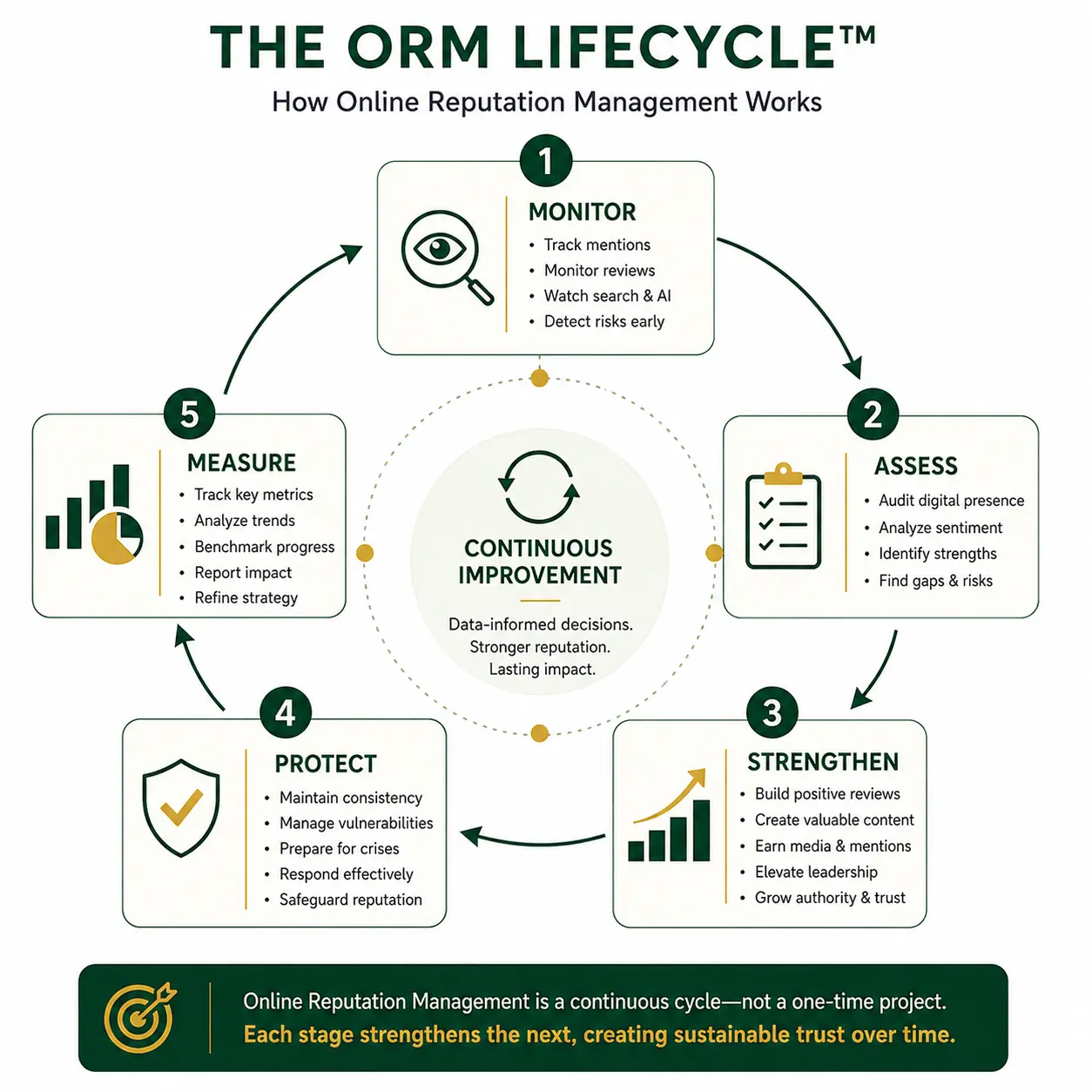
Monitor → Assess → Strengthen → Protect → Measure → Repeat
| Stage | Objective | Typical Activities |
|---|---|---|
| Monitor | Understand your current reputation | Brand monitoring, review tracking, search analysis, media monitoring, AI visibility assessment |
| Assess | Identify strengths, risks and gaps | Sentiment analysis, search audits, competitor benchmarking, trust signal evaluation |
| Strengthen | Improve the quality of digital evidence | Customer experience improvements, review generation, content development, executive branding, digital PR |
| Protect | Reduce future reputation risks | Governance policies, crisis planning, review response processes, misinformation management |
| Measure | Track progress and refine strategy | Reputation KPIs, search visibility, review trends, share of voice and trust indicators |
The five stages are interconnected. Organizations that skip the assessment phase often invest in the wrong activities, while those that focus only on protection gradually lose visibility and authority over time. Sustainable reputation management depends on maintaining momentum across the entire lifecycle.
Stage 1: Monitor What People Actually See
Many businesses monitor mentions of their brand without monitoring the experience people have when researching them.
These are not the same thing.
Monitoring should begin with the customer's perspective. Search for your business, leadership team, products, and services across the platforms your audience uses most. Review what appears in search results, AI-generated summaries, review platforms, business directories, news publications, and social media. The goal isn't simply to collect mentions—it's to understand the overall narrative they create.
Monitoring should also extend beyond your own channels. Third-party reviews, employee feedback, community discussions, and industry publications often influence perception more than content you publish yourself.
Monitor these trust signals regularly:
- Branded search results
- Customer reviews and ratings
- Google Business Profile
- AI-generated brand summaries
- News and media mentions
- Executive search visibility
- Industry directories
- Social media conversations
- Employee review platforms
- Competitor comparisons
Monitoring establishes the baseline against which every future improvement can be measured.
Stage 2: Assess the Strength of Your Trust Signals
Collecting information is valuable only if it leads to meaningful analysis.
At this stage, organizations should evaluate not only what is being said but why certain perceptions exist. A declining review score may indicate operational issues, while weak search visibility may reflect a lack of authoritative content rather than poor SEO. Similarly, limited executive visibility can reduce confidence in industries where leadership expertise directly influences buying decisions.
Rather than assessing each channel independently, evaluate how well your trust signals support one another.
A healthcare provider may have outstanding patient reviews but limited educational content. A law firm may receive excellent client testimonials yet have little independent media recognition. A financial advisory firm may publish valuable insights but lack recent reviews that validate the client experience.
Each organization has credibility—but incomplete credibility.
The objective is to identify where evidence is strong, where it is missing, and where inconsistencies create unnecessary doubt.
Questions every organization should ask:
- What appears on the first page of branded search results?
- Would a prospective customer find enough evidence to trust us?
- Are our reviews recent and representative?
- Does our leadership team demonstrate visible expertise?
- Are there recurring themes in customer feedback?
- Is our business information consistent across platforms?
- How would an AI assistant describe our organization today?
These questions often reveal opportunities that traditional SEO or review audits overlook.
Stage 3: Strengthen Your Digital Evidence
Once you've assessed your reputation, the next step is strengthening the evidence people rely on when evaluating your organization.
Many businesses make the mistake of focusing on isolated tactics such as publishing more content, requesting more reviews, or investing heavily in SEO. While each activity has value, reputation improves when every trust signal consistently reinforces the same message—that your organization is credible, capable, and trustworthy.
Rather than trying to improve everything at once, prioritize the trust signals that matter most in your industry.
A law firm may benefit most from demonstrating legal expertise and strengthening client testimonials. A healthcare provider may focus on physician profiles, patient education, and clinical authority. A hospitality business may prioritise guest reviews, local visibility, and service consistency.
The goal isn't simply to become more visible—it's to become more believable.
Stage 4: Protect Your Reputation Before a Crisis Happens
The strongest reputation strategies are proactive rather than reactive.
Most organizations begin investing in ORM only after a damaging review, negative news article, or public controversy attracts attention. By then, the focus shifts from building trust to limiting damage.
Reputation protection starts long before a crisis occurs. Establish clear ownership for review responses, media enquiries, executive communications, and business information across digital platforms. Regularly update key profiles, monitor emerging issues, and prepare response plans for high-impact scenarios.
Customers don't expect organizations to be perfect. They expect them to respond with transparency, accountability, and professionalism.
Stage 5: Measure What Matters
Reputation cannot be managed effectively without meaningful measurement.
While review ratings and search rankings are useful indicators, they tell only part of the story. A more comprehensive approach evaluates how multiple trust signals improve over time.
Consider measuring areas such as:
- Review quality and sentiment
- Branded search visibility
- Executive visibility
- Media recognition
- Customer feedback trends
- AI visibility
- Digital consistency across platforms
The objective isn't to produce a single reputation score. It's to understand whether trust is becoming stronger, more consistent, and easier for prospective customers to verify.
Successful Online Reputation Management isn't about maintaining a perfect online image. It's about continuously strengthening the digital evidence that supports trust, identifying emerging risks early, and ensuring your reputation becomes a long-term business asset rather than a reactive business challenge.
Online Reputation Management Across Different Industries
The principles of Online Reputation Management remain consistent across industries, but the factors that influence trust vary significantly depending on the decision being made.
A patient choosing a surgeon evaluates different signals than someone hiring a cybersecurity consultant or booking a hotel. Understanding these differences allows organizations to invest in the trust signals that matter most instead of applying the same strategy everywhere.
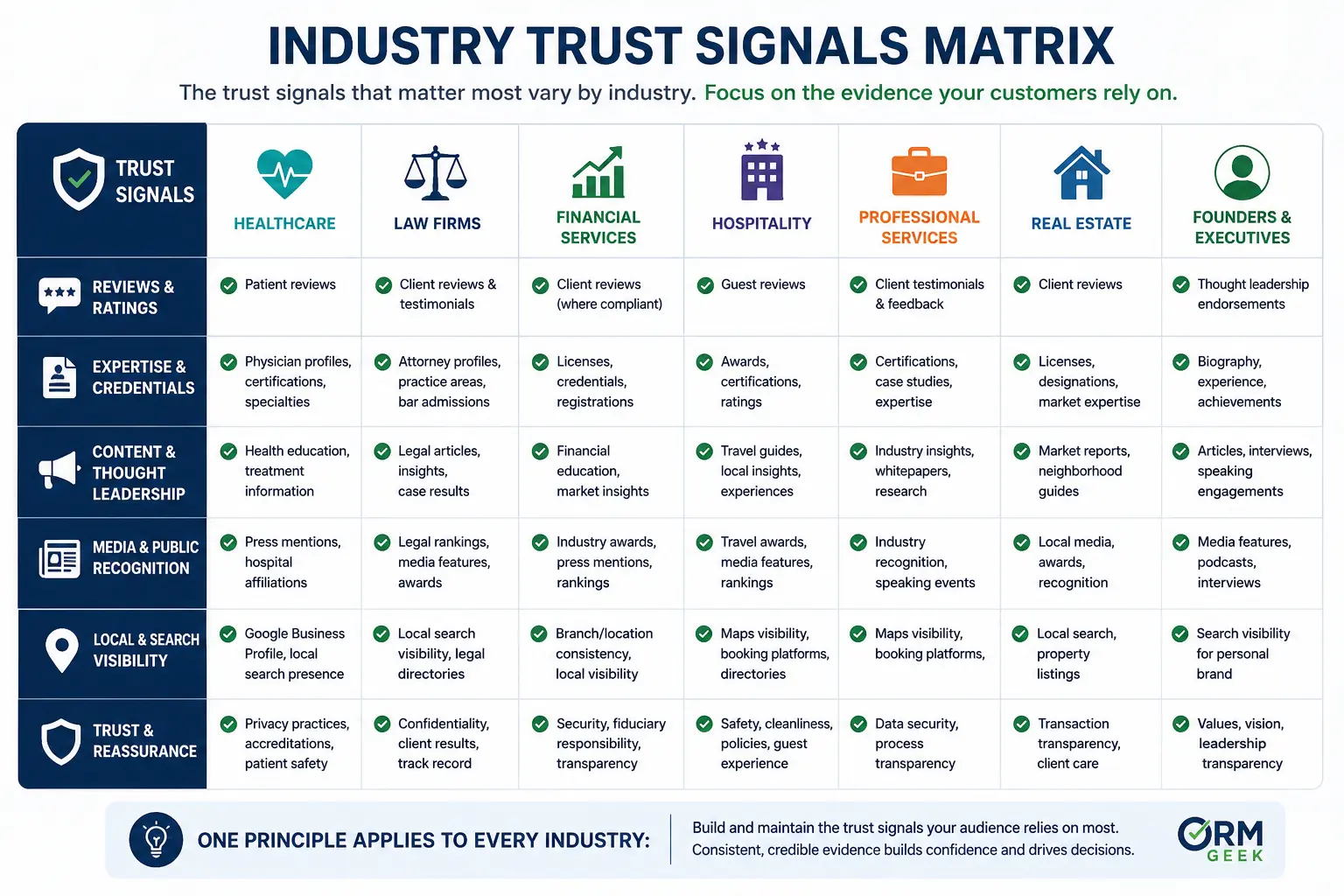
Healthcare: Trust Begins Before the First Appointment
Healthcare is one of the highest-trust industries. Patients are not simply purchasing a service—they are placing their health and wellbeing in the hands of professionals they may have never met.
Before booking an appointment, patients often research physicians, hospitals, clinics, and specialists across multiple platforms. Clinical qualifications remain important, but they're rarely evaluated in isolation. Reviews, hospital affiliations, educational content, treatment information, and communication style all contribute to patient confidence.
For healthcare organizations, reputation management supports far more than patient acquisition. It also strengthens referrals, recruitment, community trust, and long-term credibility.
Trust signals that matter most:
- Authentic patient reviews
- Complete physician profiles
- Educational health content
- Hospital affiliations
- Local search visibility
- Accurate healthcare directory listings
Law Firms: Expertise Must Be Visible
Legal services are often sought during periods of uncertainty, making trust one of the most influential factors in client decision-making.
Prospective clients compare lawyer profiles, practice areas, client testimonials, legal directories, published articles, and media recognition before making contact. Many firms possess exceptional expertise but fail to communicate it effectively online.
The firms that consistently earn trust are those that make their expertise easy to discover.
Trust signals that matter most:
- Lawyer biographies
- Client reviews and testimonials
- Practice-specific expertise
- Recognition in legal directories
- Legal insights and articles
- Speaking engagements and media coverage
Financial Services: Credibility Is the Competitive Advantage
Financial decisions involve significant personal and commercial risk, making credibility more influential than price alone.
Whether someone is selecting a wealth manager, accounting firm, investment advisor, or financial institution, they seek reassurance through multiple sources. Professional credentials, educational resources, transparent communication, executive expertise, and long-term client relationships all contribute to trust.
Even small inconsistencies—such as outdated executive profiles or incomplete regulatory information—can create unnecessary doubt during the evaluation process.
Trust signals that matter most:
- Professional credentials
- Educational financial content
- Executive visibility
- Client reviews (where compliant)
- Industry recognition
- Consistent regulatory information
Hospitality: Every Guest Becomes a Publisher
Few industries are influenced by public feedback as directly as hospitality.
Hotels, restaurants, resorts, and travel businesses generate new customer experiences every day, and many of those experiences become public through reviews, photos, videos, and social media.
Because reputation reflects operational consistency as much as marketing, exceptional service remains the strongest reputation strategy. Encouraging authentic reviews, responding professionally, and maintaining accurate local business information help reinforce that experience online.
Trust signals that matter most:
- Recent guest reviews
- Review response quality
- High-quality photography
- Accurate business listings
- Consistent guest experiences
- Visibility across travel platforms
Professional Services: Expertise Must Be Demonstrated
Consultants, agencies, architects, engineers, cybersecurity firms, and other professional service providers sell expertise rather than physical products.
Because prospective clients cannot evaluate that expertise before engagement, they look for evidence that validates it. Thought leadership, case studies, published research, certifications, speaking engagements, and executive visibility all help reduce perceived risk.
Organizations in this category often benefit more from demonstrating knowledge than promoting services.
Trust signals that matter most:
- Thought leadership
- Case studies
- Industry certifications
- Published research
- Executive visibility
- Client success stories
Real Estate: Local Reputation Drives Local Decisions
Buying or selling property is one of the most significant financial decisions most people make.
Prospective buyers and sellers evaluate agents based on local expertise, responsiveness, reviews, market knowledge, and community presence. Educational market updates, neighbourhood insights, client success stories, and consistent communication often strengthen credibility more effectively than traditional promotional messaging.
Trust signals that matter most:
- Local reviews
- Community expertise
- Market insights
- Client success stories
- Responsive communication
- Strong local search presence
Founders, Executives, and Personal Brands
Increasingly, people trust people before they trust organizations.
Founders, CEOs, physicians, lawyers, consultants, and other subject matter experts have become influential trust signals in their own right. Their interviews, articles, conference presentations, professional profiles, and public commentary often shape perceptions of the organizations they represent.
Executive reputation should therefore be viewed as a strategic business asset rather than a personal branding exercise. A visible and credible leadership team reinforces organizational expertise, while an absent or inconsistent executive presence can weaken confidence even when the business itself performs exceptionally.
One Principle Applies to Every Industry
Although every industry relies on trust, the evidence people use to establish that trust differs considerably.
The most effective Online Reputation Management strategies don't follow a generic checklist. They focus on understanding how customers make decisions and strengthening the trust signals that influence those decisions most.
Organizations that align their reputation strategy with customer expectations consistently outperform those relying on one-size-fits-all tactics.
The Biggest Online Reputation Management Mistakes Organizations Make
Most reputation problems don't begin with a crisis.
They develop gradually through overlooked opportunities, inconsistent decisions, and small gaps that weaken trust over time.
Organizations rarely struggle because they lack expertise. More often, years of experience, customer success, and professional credibility simply aren't reflected consistently across their digital presence.
Understanding these patterns is often the fastest way to strengthen an Online Reputation Management strategy before reputation becomes a business challenge.
Mistake 1: Treating ORM as Crisis Management
One of the most common misconceptions is that Online Reputation Management becomes important only when something goes wrong.
Organizations often seek help after negative media coverage, a surge in poor reviews, inaccurate search results, or a public controversy. By then, the focus has shifted from building trust to repairing it.
The strongest reputations are established long before they're tested. Businesses that consistently invest in customer experience, authoritative content, executive visibility, review management, and digital consistency are naturally more resilient because years of positive evidence outweigh isolated incidents.
Reputation should be viewed as preventive infrastructure—not emergency response.
Mistake 2: Believing Reviews Are Your Entire Reputation
Customer reviews are among the most influential trust signals, but they are only one part of a much larger reputation ecosystem.
An organization with outstanding reviews can still appear untrustworthy if its website is outdated, leadership lacks visibility, business information is inconsistent, or independent recognition is absent. Likewise, exceptional expertise cannot compensate indefinitely for recurring complaints about customer experience.
Reviews should validate your reputation. They should never be expected to carry it on their own.
Mistake 3: Confusing Visibility With Credibility
Visibility makes people aware of your business.
Credibility gives them confidence to choose it.
Many organizations invest heavily in SEO, advertising, and social media growth without considering what people discover after they arrive. If search results reveal outdated information, incomplete executive profiles, unanswered reviews, or inconsistent business details, increased visibility simply exposes credibility gaps to a larger audience.
Mistake 4: Publishing Promotional Content Instead of Helpful Content
Most business websites spend more time talking about themselves than helping their audience.
Customers rarely begin their research looking for promotional messaging. They look for answers.
Educational articles, practical guides, FAQs, case studies, industry insights, and expert commentary demonstrate knowledge long before a sales conversation begins. They position the organization as a trusted advisor rather than simply another provider competing for attention.
As AI-powered search continues to evolve, genuinely helpful content is becoming an increasingly important trust signal.
Mistake 5: Ignoring Executive Reputation
In many industries, people trust individuals before they trust organizations.
Prospective clients often research founders, partners, physicians, lawyers, consultants, and executives before deciding whether to engage with the business itself. Incomplete profiles, limited public visibility, or inconsistent messaging can reduce confidence even when the organization has an excellent reputation.
Executive visibility should therefore be viewed as a strategic business asset rather than a personal branding exercise.
Mistake 6: Measuring the Wrong Things
Organizations frequently judge reputation using isolated metrics such as review ratings, keyword rankings, follower counts, or website traffic.
While useful, these numbers reveal only part of the story.
A stronger assessment considers whether multiple trust signals are improving together. Are branded search results becoming stronger? Is customer sentiment improving? Are executives becoming recognised experts? Is third-party validation increasing?
Together, these indicators provide a far more accurate picture of reputation than any single metric.
Mistake 7: Assuming Reputation Is Marketing's Responsibility
Because reviews, websites, search visibility, and content are highly visible, reputation is often assigned exclusively to the marketing team.
In reality, every department contributes to the organization's reputation.
- Customer Service shapes customer reviews.
- Operations influence customer experience.
- Human Resources build employer reputation.
- Legal teams strengthen governance.
- Executives build public confidence.
- Marketing communicates the organization's story.
Marketing may amplify reputation, but the evidence that supports reputation is created across the entire business.
Organizations that treat reputation as a shared responsibility consistently build stronger and more resilient brands than those viewing it solely as a marketing function.
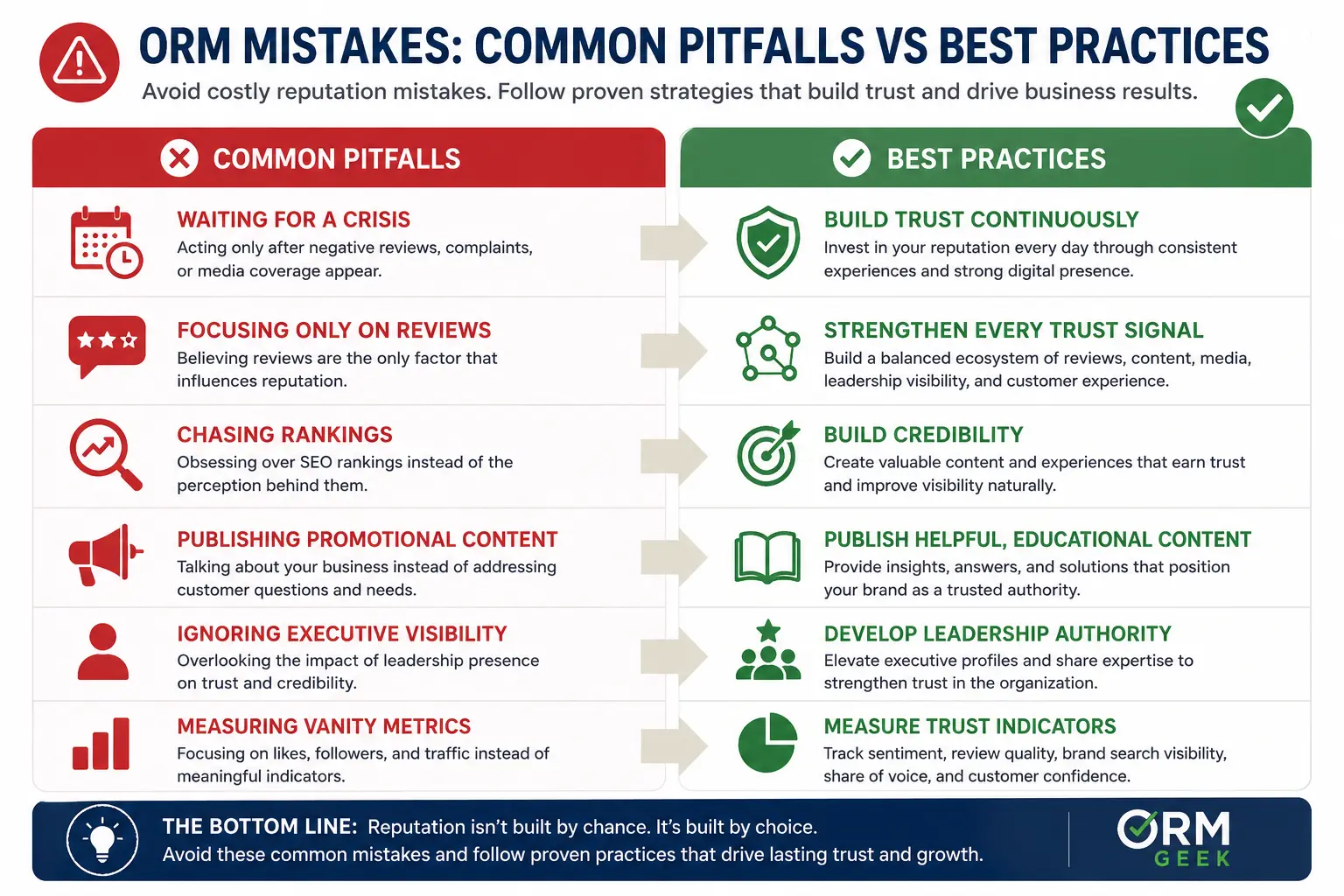
| ❌ Common Mistake | ✅ Better Approach |
|---|---|
| Wait for a crisis | Build trust continuously |
| Focus only on reviews | Strengthen every trust signal |
| Chase rankings | Build credibility |
| Publish promotional content | Publish genuinely helpful content |
| Ignore executive visibility | Develop leadership authority |
| Measure vanity metrics | Measure trust indicators |
What High-Trust Organizations Do Differently
Organizations with the strongest reputations rarely rely on a single competitive advantage.
Instead, they create alignment across customer experience, leadership, operations, communications, search visibility, and digital credibility. Every customer interaction, review, article, media mention, and executive contribution strengthens the next, making trust easier to establish and significantly harder to undermine.
The organizations that excel at Online Reputation Management don't wait for trust to become a problem. They build it deliberately, measure it continuously, and reinforce it through every customer interaction and every piece of digital evidence they create.
Reputation Is Earned Long Before Someone Becomes a Customer
Every organization has an online reputation, whether it actively manages it or not.
The question isn't whether people are researching your business—it's whether the information they find gives them enough confidence to choose you.
Today's customers, partners, investors, employees, and even AI-powered search systems evaluate organizations using a wide range of digital signals. Reviews, search results, media coverage, leadership profiles, educational content, business listings, and customer experiences all contribute to the level of trust people develop before making a decision.
The organizations that consistently earn that trust rarely rely on a single strength. They create a digital presence where every trust signal reinforces the next, making credibility visible, verifiable, and easy to understand.
Online Reputation Management is therefore much more than protecting a brand from negative reviews or responding during a crisis. It is a continuous business discipline that strengthens customer confidence, supports growth, protects long-term credibility, and helps organizations remain competitive in an increasingly digital and AI-driven world.
Whether you're a local business, a growing startup, a professional services firm, or a global enterprise, the principle remains the same:
Trust is earned before the first conversation. Your online reputation determines how easily that trust is established.
Frequently Asked Questions About Online Reputation Management
1. What is the difference between Online Reputation Management and Brand Management?
Brand Management focuses on shaping how you want people to perceive your business through messaging, positioning, and marketing. Online Reputation Management focuses on how people actually perceive your business based on reviews, search results, media coverage, customer experiences, and other public trust signals. In short, your brand creates expectations, while your reputation validates them.
2. Can a business recover from a damaged online reputation?
Yes. Most organizations can rebuild trust by addressing legitimate concerns, improving customer experience, responding professionally to feedback, and consistently strengthening positive digital evidence. Recovery rarely happens overnight, but organizations that demonstrate genuine improvements often regain credibility over time.
3. How long does Online Reputation Management usually take?
Online Reputation Management is an ongoing process rather than a one-time project. Some improvements, such as updating business information or responding to reviews, can produce quick results. Building long-term trust through stronger customer experiences, authoritative content, and increased visibility typically takes several months of consistent effort.
4. Can negative reviews actually help a business?
Yes—when they're authentic and handled professionally. Most customers don't expect a business to have a perfect rating. A balanced review profile with thoughtful responses often appears more credible than one with only five-star reviews. What matters most is how consistently an organization addresses customer feedback.
5. Should businesses respond to every online review?
As a best practice, yes. Thank customers for positive feedback and respond professionally to constructive criticism. Public responses demonstrate accountability, show that customer feedback is valued, and often influence prospective customers as much as the reviews themselves.
6. How often should organizations audit their online reputation?
Businesses should monitor their online reputation continuously while conducting a more comprehensive audit every quarter. Regular reviews help identify inconsistent business information, emerging risks, declining customer sentiment, and new opportunities to strengthen trust before they affect business performance.
7. Which online platforms have the greatest impact on reputation?
The most influential platforms vary by industry, but for most organizations they include Google Search, Google Business Profile, customer review platforms, the company website, LinkedIn, industry directories, trusted media publications, and increasingly, AI-powered search experiences. Focus on maintaining accurate and consistent information wherever your audience researches your business.
8. How is AI changing Online Reputation Management?
AI assistants increasingly summarize information from multiple trusted sources rather than relying on a single website. Reviews, media coverage, executive profiles, business listings, educational content, and third-party mentions all influence how AI systems understand and describe an organization. This makes digital consistency and credible online evidence more important than ever.
9. What is the biggest mistake organizations make with Online Reputation Management?
The biggest mistake is waiting until a reputation problem becomes public. Organizations that invest consistently in customer experience, reviews, executive visibility, helpful content, and digital credibility are far better prepared to withstand occasional criticism than those reacting only after trust has already been damaged.
10. Should Online Reputation Management be managed in-house or outsourced?
That depends on your organization's size, expertise, and objectives. Many businesses successfully manage routine activities internally while partnering with specialists for strategy, executive reputation, digital PR, search reputation, or crisis management. A hybrid approach often provides the best balance of control, efficiency, and specialist expertise.