Your online reputation is constantly evolving—whether you're actively managing it or not.
Every customer review, search result, news article, AI-generated summary, social media mention, and business listing contributes to how customers, partners, investors, employees, and other stakeholders perceive your organization. Collectively, these digital signals influence trust long before someone visits your website or contacts your business.
Today's buyers rarely rely on a single source when evaluating a company. Instead, they compare reviews, explore branded search results, visit company websites, review executive profiles, read media coverage, browse industry directories, and increasingly ask AI assistants for recommendations and summaries. Every touchpoint either reinforces confidence or creates uncertainty.
This shift has transformed Online Reputation Monitoring from an optional marketing activity into a core business function. Organizations that monitor their digital presence consistently can identify emerging issues early, measure the effectiveness of their reputation-building efforts, and respond before isolated concerns develop into larger trust challenges.
Unlike crisis management, which begins after reputational damage has occurred, reputation monitoring is proactive. It provides continuous visibility into the digital signals that influence public perception, allowing organizations to make informed decisions before small issues become costly business problems.
Throughout this guide, you'll learn what Online Reputation Monitoring is, why it has become increasingly important in the AI era, which reputation signals deserve your attention, how to build a practical monitoring strategy, and the tools, metrics, and best practices that help protect long-term trust.
Whether you're a local business, healthcare provider, law firm, financial services firm, hospitality brand, SaaS company, or enterprise organization, the principles remain the same: monitor consistently, understand what the data is telling you, and act before reputation risks affect customer confidence.
What Is Online Reputation Monitoring?
Online Reputation Monitoring is the continuous process of tracking, analyzing, and evaluating the digital information that influences how people perceive your business.
It involves monitoring customer reviews, search engine results, AI-generated answers, news coverage, social media conversations, business listings, executive mentions, and other publicly available information that shapes trust and credibility.
Unlike a one-time reputation audit, monitoring is an ongoing discipline. It helps organizations understand how their reputation changes over time, identify emerging risks, and measure whether their reputation management efforts are producing meaningful results.
In today's digital environment, reputation can change quickly. A negative customer experience, inaccurate business listing, misleading AI-generated summary, or viral social media post can influence public perception within hours. Continuous monitoring helps organizations detect these changes early, giving them time to respond strategically rather than react under pressure.
Online Reputation Monitoring vs. Online Reputation Management
Although the terms are often used interchangeably, they represent different parts of a successful reputation strategy.
| Online Reputation Monitoring | Online Reputation Management |
|---|---|
| Tracks reputation signals | Improves reputation signals |
| Identifies changes and trends | Takes corrective action |
| Detects potential risks | Builds long-term trust |
| Measures reputation health | Executes reputation strategy |
| Provides insights for decision-making | Strengthens credibility across digital channels |
Think of monitoring as the intelligence layer that supports Online Reputation Management. Monitoring tells you what is changing, while management determines what to do about it.
Organizations that invest only in reputation management without effective monitoring often respond too late because they lack visibility into the issues developing around their brand.
What Does Online Reputation Monitoring Include?
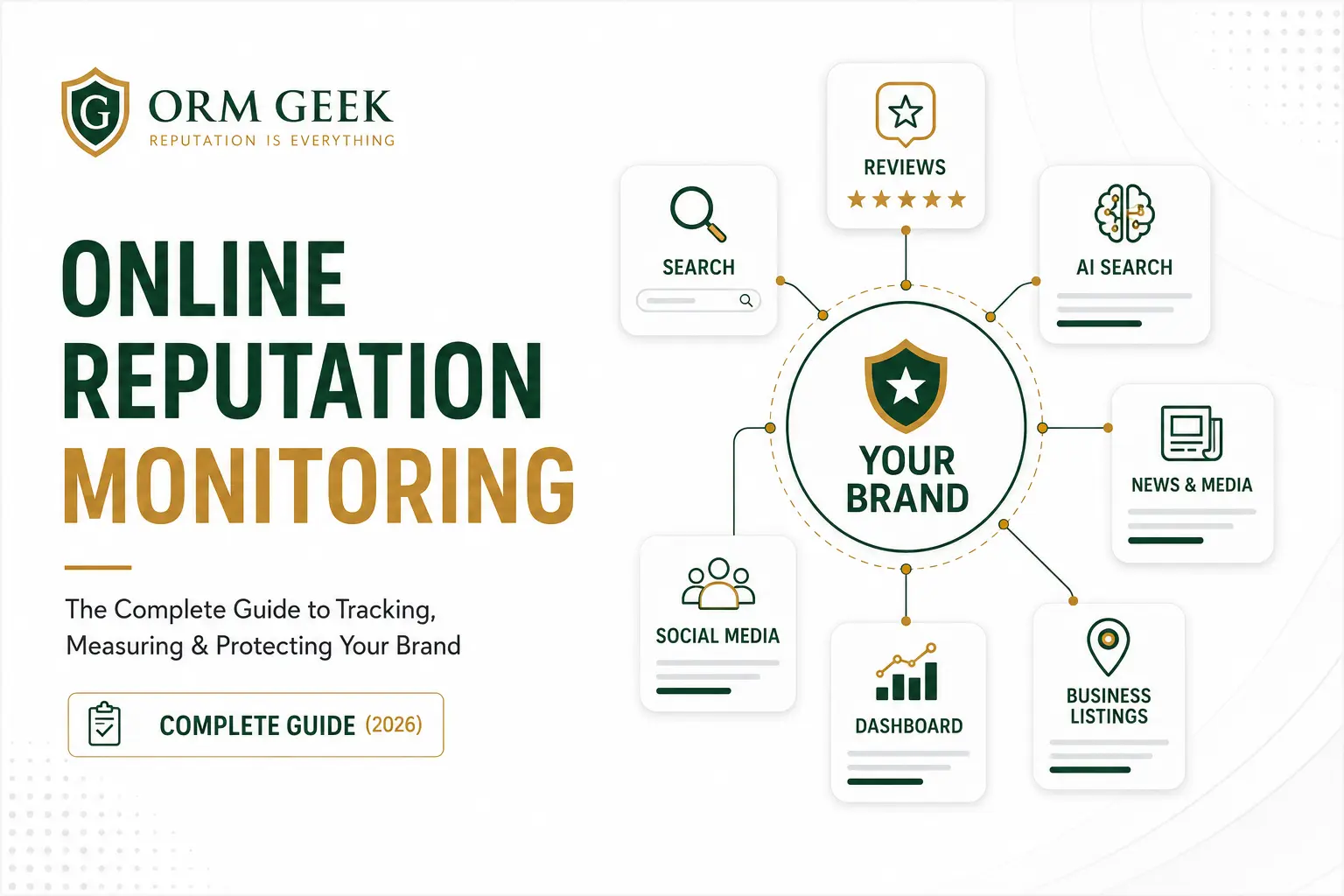
An effective monitoring strategy extends well beyond customer reviews. It should cover every major source of digital evidence that influences stakeholder trust.
This typically includes:
- Customer reviews and ratings
- Branded search results
- AI-generated summaries and answers
- News articles and media coverage
- Social media mentions and discussions
- Google Business Profile activity
- Business directories and citations
- Executive and leadership visibility
- Industry forums and communities
- Competitor reputation trends
Each of these sources contributes to the overall perception of your business. Monitoring them together provides a more accurate picture of your reputation than evaluating any single channel in isolation.
Example
Imagine a prospective client researching your business for the first time.
They search your company name on Google, review your Google ratings, ask an AI assistant about your services, visit your website, explore your LinkedIn page, and read a recent news article mentioning your organization.
Individually, each source provides only part of the story.
Together, they create the impression that determines whether the client feels confident moving forward.
Online Reputation Monitoring helps ensure that this collective picture accurately reflects your business, rather than being shaped by outdated information, unanswered reviews, or inconsistent digital signals.
Online Reputation Monitoring provides continuous visibility into the digital signals that shape trust, helping organizations identify emerging risks early and make informed decisions that support long-term reputation management.
Why Online Reputation Monitoring Matters More Than Ever
Online Reputation Monitoring has always been important, but the way people evaluate businesses has changed dramatically over the past decade.
Customers no longer rely solely on advertising, referrals, or company websites when making decisions. Instead, they conduct independent research across multiple digital platforms, comparing information from search engines, review websites, social media, news publications, business directories, and AI-powered search experiences.
As a result, your reputation is no longer defined by what your organization says about itself. It is shaped by the collective body of digital evidence available online.
Monitoring allows organizations to understand how that evidence evolves over time and identify changes before they begin influencing customer behaviour.
Reputation Changes Faster Than Most Businesses Realize
Digital reputation is dynamic.
A single customer review, media article, executive interview, or viral social media post can influence public perception within hours. AI-powered search experiences can also surface new information almost immediately, making it easier than ever for people to discover both positive and negative content.
Without continuous monitoring, organizations often become aware of reputation issues only after they begin affecting enquiries, customer confidence, or revenue.
Businesses that monitor consistently can identify emerging trends early, understand what caused them, and respond before isolated issues develop into long-term reputation challenges.
Customer Research Has Become More Complex
Today's buying journey rarely follows a straight path.
Before contacting a business, prospective customers often validate information across multiple sources to reduce uncertainty and build confidence.
A typical research journey may include:
- Searching the company on Google
- Reading customer reviews
- Visiting the company website
- Reviewing executive LinkedIn profiles
- Exploring recent news coverage
- Checking business directories
- Asking AI assistants for summaries or recommendations
Each interaction contributes another trust signal.
If these signals are consistent, confidence grows. If they contradict one another, uncertainty increases.
Monitoring helps organizations ensure these touchpoints present an accurate and credible representation of their business.
AI Has Changed How Reputation Is Discovered
AI-powered search has fundamentally changed how people consume information.
Instead of reviewing multiple websites individually, users increasingly rely on AI assistants to summarize businesses, compare providers, answer questions, and recommend companies.
These systems generate responses using information gathered from trusted public sources, including websites, reviews, news articles, business directories, and other authoritative content.
This means businesses must monitor not only traditional search results but also the broader digital ecosystem that influences AI-generated responses.
Organizations that actively monitor these sources are better positioned to identify inaccuracies, strengthen authoritative content, and improve how their brand is represented across AI-powered platforms.
Reputation Monitoring Supports Better Business Decisions
Online Reputation Monitoring is not simply about identifying negative comments.
It provides valuable business intelligence that helps organizations understand how customers perceive their brand, identify operational issues, measure the effectiveness of reputation-building initiatives, and benchmark performance against competitors.
When monitored consistently, reputation data can reveal trends such as:
- Recurring customer concerns
- Improving or declining sentiment
- Changes in review quality
- Emerging service issues
- Brand visibility across search engines
- Executive reputation trends
- Competitive positioning within the industry
These insights allow organizations to make proactive decisions rather than reacting after problems become visible.
Monitoring Is Prevention, Not Reaction
Many businesses begin paying attention to their reputation only after something goes wrong.
A negative review goes viral.
An inaccurate news article appears.
A misleading AI-generated summary gains visibility.
An executive faces public criticism.
By that point, the focus shifts from strengthening trust to limiting reputational damage.
Organizations that monitor continuously are far more likely to detect warning signs early, giving them the opportunity to respond strategically before issues escalate into full-scale reputation crises.
Online Reputation Monitoring helps organizations identify reputation changes early, understand how customers and AI systems perceive their brand, and respond proactively before small issues become significant business risks.
The ORM Geek Reputation Monitoring Framework™
Effective Online Reputation Monitoring isn't about checking reviews occasionally or setting up a few Google Alerts. It requires a structured process that helps organizations detect changes, interpret trends, prioritize action, and continuously improve their digital reputation.
At ORM Geek, we approach reputation monitoring as an ongoing business cycle rather than a one-time activity.
The ORM Geek Reputation Monitoring Framework™ provides a practical methodology for monitoring, understanding, and improving your reputation across every major digital touchpoint.
The Six Stages of Reputation Monitoring
| Stage | Purpose | Key Question |
|---|---|---|
| Discover | Identify where your reputation exists online | Where are people finding information about us? |
| Monitor | Track changes across key reputation channels | What has changed since our last review? |
| Analyze | Understand trends, sentiment, and root causes | Why is this happening? |
| Respond | Take appropriate action based on insights | What should we do next? |
| Measure | Evaluate performance using meaningful KPIs | Are our actions improving trust? |
| Improve | Refine processes and strengthen reputation over time | How do we continuously build credibility? |
📍Insert Graphic Here: ORM Geek Reputation Monitoring Framework™
Flow: Discover → Monitor → Analyze → Respond → Measure → Improve
Rather than treating reputation as a series of isolated incidents, the framework encourages organizations to monitor continuously, respond strategically, and use data to strengthen long-term trust.
Stage 1: Discover Your Reputation Landscape
Before you can monitor your reputation, you need to understand where it exists.
Most businesses focus on obvious channels such as Google Reviews or social media, but customers often gather information from many different sources before making a decision.
These may include:
- Search engine results
- Review platforms
- Google Business Profile
- Company website
- AI-generated answers
- News and media coverage
- Industry directories
- Executive LinkedIn profiles
- Community forums
- Video platforms and podcasts
The goal is to map every location where your business is publicly represented.
Without this visibility, important reputation signals may go unnoticed simply because no one is actively monitoring them.
Stage 2: Monitor Changes Continuously
Once you've identified the relevant channels, the next step is to monitor them consistently.
This includes tracking new reviews, media mentions, search rankings, AI-generated summaries, executive visibility, customer feedback, and competitor activity.
Monitoring should focus on identifying meaningful changes rather than collecting large volumes of data.
For example, one negative review may not require immediate action. However, a pattern of similar complaints appearing across multiple platforms could indicate an operational issue that deserves attention.
Consistency is more valuable than frequency. A well-defined monitoring routine produces better results than sporadic checks during busy periods.
Stage 3: Analyze What the Data Is Telling You
Collecting information has little value unless it leads to actionable insight.
Analysis helps organizations distinguish between isolated events and recurring trends.
Instead of asking:
"Did we receive a negative review?"
Ask:
- Are similar concerns appearing repeatedly?
- Which customer touchpoints generate the most complaints?
- Has sentiment changed over the past six months?
- Are competitors improving faster than we are?
- Are AI platforms accurately representing our business?
Looking for patterns rather than individual incidents leads to better strategic decisions.
Stage 4: Respond Strategically
Not every reputation issue requires the same response.
Some situations call for a public reply to a customer review.
Others require updating business information, publishing new educational content, correcting inaccurate media coverage, or improving customer experience behind the scenes.
Effective responses are:
- Timely
- Transparent
- Professional
- Consistent
- Solution-focused
Organizations that respond thoughtfully often strengthen trust, even when addressing criticism.
Stage 5: Measure Progress
Monitoring should produce measurable outcomes.
Rather than relying solely on review ratings, organizations should evaluate multiple trust indicators, including:
- Review trends
- Search visibility
- Brand sentiment
- Media mentions
- AI representation
- Response times
- Executive visibility
- Customer feedback patterns
Tracking these metrics over time provides a clearer understanding of whether reputation is improving.
Stage 6: Improve Continuously
Reputation is never static.
Customer expectations evolve.
Search algorithms change.
AI systems learn from new information.
New competitors enter the market.
The final stage of the framework focuses on continuous improvement.
Organizations should regularly review monitoring insights, refine their processes, strengthen weak trust signals, and adapt their strategy as digital behaviour changes.
Businesses that view reputation as an ongoing business discipline—not a reactive marketing activity—are significantly better positioned to build long-term credibility.
The ORM Geek Reputation Monitoring Framework™ transforms monitoring from a reactive task into a continuous improvement process. By discovering where your reputation exists, monitoring changes, analyzing trends, responding strategically, measuring results, and refining your approach, you can protect and strengthen trust before reputation issues affect business performance.
What Every Business Should Monitor
Knowing how to monitor your reputation is only part of the equation. The next step is understanding what deserves your attention.
Many organizations limit reputation monitoring to customer reviews or social media mentions. While these channels are important, they represent only a fraction of the digital evidence that influences trust.
Today's customers research businesses across multiple platforms before making a decision. AI-powered search experiences have expanded this journey even further by aggregating information from numerous public sources into a single response.
An effective monitoring strategy should therefore cover every major touchpoint that contributes to your digital reputation.
1. Customer Reviews and Ratings
Customer reviews remain one of the strongest indicators of public trust.
Beyond influencing purchasing decisions, reviews provide valuable insights into customer expectations, service quality, and operational performance. Monitoring reviews consistently allows businesses to identify recurring issues, measure customer satisfaction, and respond before isolated complaints become broader reputation concerns.
Focus on monitoring:
- Google Reviews
- Facebook Reviews
- Industry-specific review platforms
- Third-party marketplaces
- Customer testimonials published elsewhere
Don't just monitor your average rating. Pay attention to trends such as:
- Review volume
- Review frequency
- Recurring themes
- Customer sentiment
- Response times
- Unanswered reviews
These patterns often reveal more than the rating itself.
2. Branded Search Results
Search engines often create the first impression of your business.
When someone searches for your company, leadership team, products, or services, the results should reinforce credibility rather than create uncertainty.
Monitor branded searches regularly to identify:
- New search results
- Outdated information
- Negative content
- Duplicate listings
- Incorrect business details
- Changes in search visibility
Search results change continuously, particularly when new content, news, or reviews appear.
Regular monitoring helps ensure that prospective customers encounter accurate and trustworthy information.
3. AI-Generated Search Results
AI-powered search has become a new reputation channel.
Platforms such as ChatGPT, Google AI Overviews, Gemini, Microsoft Copilot, and Perplexity increasingly summarize businesses instead of directing users to individual websites.
These summaries may reference:
- Reviews
- News articles
- Company websites
- Business directories
- Public databases
- Industry publications
Businesses should periodically evaluate how AI platforms describe their organization by asking questions such as:
- What does this company do?
- Is this business trustworthy?
- What are customers saying?
- Who are its competitors?
- Why should someone choose this company?
Comparing responses across different AI platforms can help identify inaccuracies, missing information, or opportunities to strengthen your digital authority.
4. News and Media Coverage
Media coverage significantly influences public credibility.
Positive news articles, interviews, research publications, awards, and expert commentary strengthen authority. Conversely, inaccurate reporting or outdated articles can continue shaping perception long after publication.
Monitor:
- News websites
- Press releases
- Industry publications
- Business magazines
- Blogs
- Podcasts
- Video interviews
Don't simply monitor mentions—evaluate whether the overall media narrative accurately reflects your organization.
5. Social Media Conversations
Not every reputation conversation happens directly on your official social media pages.
Customers frequently discuss brands through comments, shares, community groups, hashtags, and public conversations that businesses never receive notifications for.
Monitoring social platforms helps identify:
- Brand mentions
- Customer feedback
- Emerging complaints
- Positive advocacy
- Viral discussions
- Industry conversations
The goal isn't to respond to every mention but to understand broader sentiment and identify conversations that require attention.
6. Business Listings and Directories
Inaccurate business information creates unnecessary doubt.
Customers expect consistent information regardless of where they discover your organization.
Monitor business listings to ensure that your:
- Business name
- Address
- Phone number
- Website
- Business hours
- Services
- Categories
- Contact information
remain accurate across every major platform.
Even small inconsistencies can weaken trust, particularly in healthcare, legal, financial, and local service industries.
7. Executive and Leadership Reputation
Increasingly, people research individuals before they research organizations.
Founders, CEOs, physicians, lawyers, consultants, and senior executives often become trust signals in their own right.
Monitor:
- Executive search results
- LinkedIn visibility
- Media mentions
- Conference appearances
- Published articles
- Interviews
- Professional profiles
For many organizations, executive credibility directly influences organizational credibility.
8. Competitor Reputation
Reputation monitoring shouldn't stop with your own business.
Tracking competitors helps provide context for your performance and identify emerging industry trends.
Compare:
- Review ratings
- Customer sentiment
- Search visibility
- Media coverage
- AI-generated summaries
- Content quality
- Executive visibility
Competitive monitoring isn't about copying competitors—it's about understanding how your reputation compares within your market.
Effective Online Reputation Monitoring extends far beyond reviews. Organizations should continuously monitor customer feedback, search results, AI-generated responses, media coverage, social conversations, business listings, executive visibility, and competitor activity to gain a complete picture of how their brand is perceived online.
Best Online Reputation Monitoring Tools
The right reputation monitoring tool depends on your organization's size, industry, and monitoring objectives.
A local business may only need Google Alerts and regular review monitoring, while an enterprise organization may require AI-powered media monitoring, sentiment analysis, competitive benchmarking, and executive reputation tracking across hundreds of digital sources.
Rather than asking "What's the best reputation monitoring tool?", ask:
"What information do we need to monitor consistently?"
The answer will determine which category of tools best fits your business.
Free Reputation Monitoring Tools
Small businesses and startups can establish an effective monitoring routine without investing in enterprise software.
Several free tools provide valuable visibility into search results, customer reviews, and online mentions.
| Tool | Best For | What It Monitors |
|---|---|---|
| Google Alerts | Brand mentions | News articles, blogs, websites |
| Google Business Profile | Local businesses | Customer reviews and profile activity |
| Google Search | All businesses | Branded search results |
| Google Search Console | Website owners | Search visibility and indexing |
| Google Maps | Local reputation | Reviews and business information |
While these tools require more manual effort, they provide an excellent starting point for organizations building their reputation monitoring process.
Brand Monitoring Platforms
As businesses grow, manually checking multiple platforms becomes increasingly difficult.
Dedicated brand monitoring platforms automatically track online mentions across websites, blogs, forums, news publications, and social media, helping organizations identify conversations that might otherwise go unnoticed.
Popular solutions include:
- Brand24
- Mention
- Talkwalker
- Meltwater
These platforms are particularly valuable for organizations with an active media presence or brands that receive frequent online discussions.
Review Management Platforms
For businesses that receive reviews across multiple websites, review management software simplifies monitoring and response workflows.
These platforms typically allow organizations to:
- Monitor reviews from multiple platforms
- Receive notifications for new reviews
- Respond from a central dashboard
- Track review trends
- Measure customer sentiment
- Generate performance reports
Well-known review management solutions include:
- Birdeye
- ReviewTrackers
- Reputation.com
- Podium
Businesses with multiple locations often benefit most from centralized review management.
Social Media Monitoring Tools
Not every reputation conversation appears in search results or review platforms.
Social listening tools help organizations monitor brand mentions, hashtags, customer discussions, and industry conversations across major social networks.
Common platforms include:
- Sprout Social
- Hootsuite
- Brandwatch
- Buffer (monitoring features)
These tools provide valuable insight into customer sentiment and emerging conversations before they become broader reputation issues.
Enterprise Reputation Intelligence Platforms
Large organizations often require a more comprehensive view of reputation.
Enterprise platforms combine multiple monitoring functions into a single system, including:
- News monitoring
- Media intelligence
- Sentiment analysis
- Competitive benchmarking
- Executive monitoring
- Crisis alerts
- Reputation reporting
- Global brand tracking
Solutions such as Meltwater, Talkwalker, and Cision are designed for organizations managing reputation across multiple brands, markets, or regions.
Choosing the Right Monitoring Tool
No single platform monitors every reputation signal perfectly.
Most organizations achieve better results by combining several tools rather than relying on one solution.
When evaluating reputation monitoring software, consider whether it can:
- Monitor the channels that matter to your business
- Deliver real-time alerts for important changes
- Track review trends and customer sentiment
- Measure branded search visibility
- Support AI-era reputation monitoring
- Generate meaningful reports and dashboards
- Scale with your organization's growth
Remember that software is only one part of an effective monitoring strategy. Clear processes, defined responsibilities, and regular reviews are equally important.
Reputation monitoring tools help automate data collection, but they don't replace strategy. Choose tools based on the reputation signals you need to monitor, integrate them into a consistent monitoring process, and use the insights they provide to strengthen trust over time.
How to Measure Your Online Reputation Effectively
Monitoring helps you understand what's happening. Measurement helps you determine whether your reputation is improving over time.
Many organizations evaluate their reputation using only one or two metrics, such as their average Google rating or the number of followers on social media. While these indicators are useful, they provide only a partial view of how customers and stakeholders perceive the business.
A stronger approach is to evaluate reputation across multiple trust signals and identify trends rather than focusing on isolated numbers.
Why Traditional Metrics Aren't Enough
An average review rating doesn't explain why customer sentiment is improving or declining.
Similarly, increased website traffic doesn't necessarily indicate stronger trust. A business may attract more visitors while simultaneously experiencing declining review quality, negative media coverage, or inaccurate AI-generated summaries.
To understand reputation accurately, organizations should evaluate multiple indicators together.
For example:
- A law firm may have excellent client reviews but little executive visibility.
- A hotel may rank highly in search results but receive declining guest satisfaction scores.
- A healthcare provider may publish authoritative content but have inconsistent business listings across medical directories.
Each scenario highlights a different reputation gap that requires a different solution.
The ORM Geek Reputation Monitoring Scorecard™
Rather than relying on a single reputation score, ORM Geek recommends evaluating performance across seven core dimensions.
| Area | Key Question |
|---|---|
| Customer Reviews | Are customers consistently sharing positive, recent experiences? |
| Search Visibility | Do branded search results reinforce trust and credibility? |
| Media & Authority | Is your expertise being validated by trusted third-party sources? |
| Executive Presence | Are leaders visible and recognised as credible experts? |
| Customer Sentiment | Are recurring complaints decreasing over time? |
| AI Visibility | Do AI assistants accurately represent your business? |
| Digital Consistency | Is your business information accurate across all major platforms? |
📍Insert Graphic Here: ORM Geek Reputation Monitoring Scorecard™
Design the scorecard as a clean dashboard-style infographic showing the seven monitoring categories with a simple rating scale for each.
Unlike traditional reputation scores, this framework doesn't attempt to reduce trust to a single number.
Instead, it highlights strengths, identifies weaknesses, and helps organizations prioritize their next improvement opportunities.
Reputation Metrics That Matter Most
Every organization should establish a core set of Key Performance Indicators (KPIs) to track over time.
Some of the most valuable reputation metrics include:
- Average review rating
- Review volume and growth
- Review response rate
- Review response time
- Customer sentiment trends
- Brand mention volume
- Share of positive versus negative mentions
- Branded search visibility
- AI-generated brand accuracy
- Executive media mentions
- Authority-building backlinks
- Business listing accuracy
Rather than measuring these metrics in isolation, compare them month over month and quarter over quarter to identify meaningful trends.
Focus on Trends, Not Individual Events
Every business receives occasional criticism.
A single negative review or unfavourable social media comment doesn't necessarily indicate a reputation problem.
What matters is whether similar issues continue appearing over time.
Ask questions such as:
- Are complaints becoming more frequent?
- Is customer sentiment improving or declining?
- Are response times getting faster?
- Is media coverage becoming more positive?
- Are AI-generated summaries becoming more accurate?
- Are branded search results improving?
Trend analysis provides a far more reliable picture of reputation health than reacting to individual events.
Build a Reputation Dashboard
Organizations that take reputation seriously often consolidate their monitoring data into a single dashboard.
A reputation dashboard doesn't need to be complex. It simply brings together the most important indicators in one place, making it easier to identify trends and take action.
A practical dashboard might include:
- Review performance
- Customer sentiment
- Search visibility
- AI representation
- Media mentions
- Executive visibility
- Competitor benchmarking
- Open reputation issues
Reviewing this dashboard monthly helps ensure that reputation becomes part of ongoing business decision-making rather than an occasional marketing exercise.
Effective Online Reputation Monitoring isn't about collecting more data—it's about measuring the trust signals that matter most. By tracking multiple reputation indicators over time, organizations can identify emerging risks, measure progress, and make informed decisions that strengthen long-term credibility.
Common Online Reputation Monitoring Mistakes (And How to Avoid Them)
Even businesses that understand the importance of reputation monitoring often make avoidable mistakes that limit its effectiveness.
In many cases, the problem isn't a lack of tools or resources. It's the absence of a structured process for identifying meaningful changes and acting on them consistently.
Recognizing these common pitfalls can help your organization build a more proactive and resilient reputation strategy.
Mistake #1: Monitoring Only Customer Reviews
Customer reviews are one of the most visible trust signals, but they represent only one part of your digital reputation.
Prospective customers also evaluate search results, news articles, AI-generated summaries, executive profiles, business listings, and social media conversations before making a decision.
Focusing exclusively on reviews creates blind spots that can allow other reputation issues to go unnoticed.
Best Practice: Monitor every major source of digital evidence, not just review platforms.
Mistake #2: Waiting for a Crisis Before Monitoring
Many organizations begin monitoring their reputation only after receiving negative publicity or experiencing a surge in poor reviews.
By then, the conversation has already shifted from prevention to damage control.
Continuous monitoring helps businesses detect warning signs early, giving them more time and flexibility to respond effectively.
Best Practice: Make reputation monitoring an ongoing business process rather than a crisis response activity.
Mistake #3: Collecting Data Without Taking Action
Monitoring software can generate thousands of notifications each month.
However, collecting data alone doesn't improve reputation.
Insights must lead to action—whether that means responding to customer feedback, updating inaccurate information, improving operational processes, or strengthening authoritative content.
Best Practice: Establish clear ownership so that every important reputation issue has a defined response process.
Mistake #4: Ignoring AI-Powered Search
Many organizations still focus exclusively on traditional search engines.
However, customers increasingly ask AI assistants questions such as:
- Is this company trustworthy?
- What do customers say about this business?
- Who are the best providers in this industry?
- What are this company's strengths and weaknesses?
If you never evaluate how AI platforms describe your organization, you may miss an important part of your digital reputation.
Best Practice: Regularly review AI-generated summaries alongside traditional search results.
Mistake #5: Assigning Reputation to Marketing Alone
Marketing teams often manage reviews, content, and social media, but reputation is influenced by the entire organization.
Customer service affects reviews.
Operations affect customer satisfaction.
Leadership affects public confidence.
Human Resources influences employer reputation.
Legal and compliance teams influence organizational credibility.
Treating reputation as a shared business responsibility creates stronger and more sustainable outcomes.
Best Practice: Establish cross-functional ownership with clearly defined responsibilities for monitoring, escalation, and response.
Mistake #6: Measuring Individual Events Instead of Trends
A single negative review rarely indicates a reputation problem.
Likewise, one positive media mention doesn't automatically strengthen long-term credibility.
Meaningful insights come from identifying patterns over weeks, months, and quarters.
Organizations should evaluate whether sentiment is improving, complaints are recurring, response times are decreasing, and trust signals are becoming stronger over time.
Best Practice: Focus on long-term trends rather than reacting emotionally to isolated events.
Build a Weekly Online Reputation Monitoring Routine
One of the biggest reasons businesses struggle with reputation monitoring is inconsistency.
Monitoring shouldn't depend on whether someone remembers to check Google Reviews or receives an unexpected customer complaint. Instead, it should become a recurring business process with clearly defined responsibilities and review schedules.
The following routine provides a practical framework that organizations of any size can adopt.
Daily Tasks
Spend 10–15 minutes reviewing high-priority reputation signals.
Check for:
- New customer reviews
- Urgent brand mentions
- Customer complaints
- Google Business Profile activity
- Significant social media discussions
Respond promptly to issues that require immediate attention.
Weekly Tasks
Conduct a broader review of your digital reputation.
Review:
- Branded Google search results
- AI-generated summaries
- Review trends
- Competitor activity
- Business listings
- Executive mentions
- News coverage
Look for patterns rather than isolated events.
Monthly Tasks
Measure progress using your reputation dashboard.
Evaluate:
- Customer sentiment
- Review growth
- Response performance
- Search visibility
- AI representation
- Authority-building efforts
- Media mentions
- Reputation KPIs
Use these insights to identify priorities for the following month.
📍Insert Graphic Here: Weekly Reputation Monitoring Checklist
Design: A clean three-column infographic showing Daily, Weekly, and Monthly monitoring activities with checkmark icons and ORM Geek branding.
Successful Online Reputation Monitoring depends on consistency rather than complexity. By avoiding common mistakes and following a structured daily, weekly, and monthly routine, organizations can detect emerging risks early, respond with confidence, and continuously strengthen customer trust.
Turning Reputation Insights into Business Growth
Online Reputation Monitoring is about more than tracking reviews or responding to online mentions. It's about understanding the digital signals that influence customer trust and using those insights to make better business decisions.
Organizations that monitor consistently are better equipped to identify emerging risks, uncover opportunities for improvement, and respond before small issues become larger reputation challenges. As AI-powered search and digital research continue to shape buying decisions, maintaining visibility into your online reputation will become even more important.
The businesses that earn lasting trust aren't necessarily the ones with the fewest negative comments—they're the ones that listen, learn, and improve continuously.
Frequently Asked Questions
1.What is the purpose of Online Reputation Monitoring?
Online Reputation Monitoring helps businesses track, analyze, and understand the digital information that influences public perception. It enables organizations to identify reputation risks early, respond to customer feedback, and maintain trust across reviews, search engines, AI platforms, news websites, and social media.
2. What is the difference between Online Reputation Monitoring and Online Reputation Management?
Online Reputation Monitoring focuses on tracking and measuring reputation signals, while Online Reputation Management involves taking action to improve, protect, and strengthen those signals. Monitoring identifies issues; management resolves them.
3. Why is Online Reputation Monitoring important for small businesses?
Small businesses often rely heavily on local search and customer reviews to attract new customers. Regular monitoring helps ensure business information remains accurate, customer feedback is addressed promptly, and potential reputation issues are identified before they affect sales or local visibility.
4. Which platforms should businesses monitor?
Businesses should monitor every platform that influences customer trust, including Google Search, Google Business Profile, review websites, AI-generated search results, social media, news publications, business directories, executive profiles, and relevant industry forums.
5. How often should I monitor my online reputation?
Customer reviews, Google Business Profile activity, and social media should ideally be monitored daily. Search results, AI-generated summaries, and news coverage should be reviewed weekly, while business listings, executive visibility, and overall reputation performance should be assessed monthly.
6. Can AI-generated search results affect my online reputation?
Yes. AI assistants increasingly summarize businesses using publicly available information from websites, reviews, news articles, and other trusted sources. Monitoring how AI platforms represent your business helps identify inaccuracies and opportunities to strengthen your digital authority.
7. What are the best tools for Online Reputation Monitoring?
The best tool depends on your needs. Small businesses can start with Google Alerts and Google Business Profile, while larger organizations may benefit from platforms such as Brand24, Mention, Meltwater, Talkwalker, Birdeye, or ReviewTrackers for broader monitoring and reporting.
8. What metrics should I track to measure my online reputation?
Focus on metrics that reflect trust and customer perception, including review ratings, review volume, customer sentiment, branded search visibility, media mentions, AI-generated representation, response times, business listing accuracy, and executive visibility.
9. Who should be responsible for monitoring an organization's reputation?
Reputation monitoring should be a shared responsibility. Marketing may coordinate monitoring activities, but customer service, operations, leadership, HR, and communications teams all contribute to the organization's reputation and should play a role in responding to relevant issues.
10. What happens if businesses don't monitor their online reputation?
Without regular monitoring, organizations may miss negative reviews, inaccurate information, declining customer sentiment, misleading AI-generated summaries, or emerging reputation risks. Over time, these issues can reduce customer trust, impact search visibility, and affect business growth.